

Key Takeaways
Automated die handling can make repetitive heavy-load transportation more consistent and easier to coordinate with production workflows.
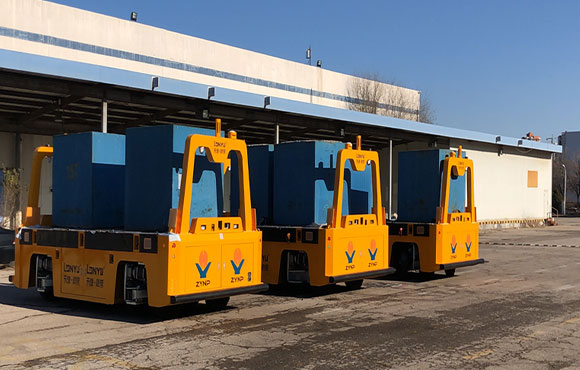
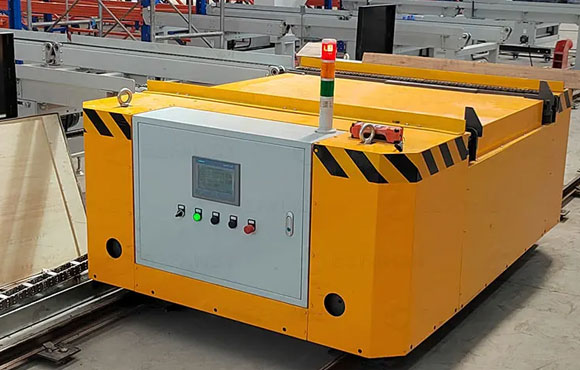
Automated guided vehicle applications are particularly useful when molds, dies, or tooling move repeatedly between defined areas.
The right solution depends on payload, mold dimensions, rack design, positioning requirements, navigation, floor conditions, safety, and operating cycles.
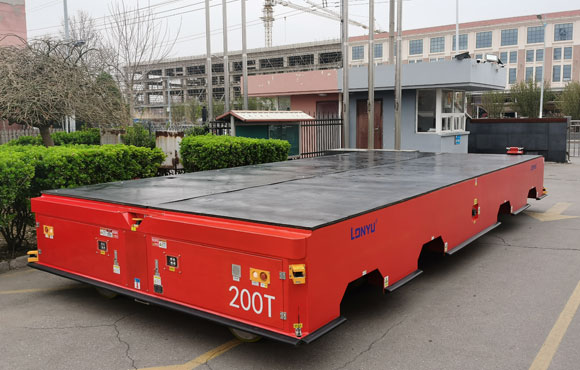
Lonyu Robot的 Automatic Mold Transfer System provides a 10-ton published load capacity and hydraulic platform lifting for a specific heavy-mold transfer configuration.
引言
Moving large molds in a manufacturing plant is more complex than handling standard pallets. Dies are heavy, oversized, and require precise positioning. They typically move between storage, production, and maintenance areas in a fixed workflow.
传统 物料搬运设备 such as forklifts, cranes, and transfer carts is still widely used. However, repeated die transfers can increase operator workload and logistics complexity, especially when the same routes are used frequently.
Automation is most effective in stable, predictable workflows where load paths and handling steps are clearly defined. NIST notes that AGVs are typically part of broader automated material-handling systems that work alongside storage, retrieval, and transfer equipment.
Why Is Automated Die Handling Becoming Important in Manufacturing?
Limitations of Manual Mold Transport
Traditional mold handling usually requires multiple steps such as lifting, moving, aligning, and unloading. Each step adds time and increases the chance of delays or positioning errors, especially when dealing with large and heavy dies.
Beyond lifting capacity, operators must also manage space constraints, floor conditions, and precise alignment with storage or production stations. Even suitable equipment can struggle if positioning is not accurate or access is limited.
This is where 自动导引车 applications become useful. AGVs are designed to follow predefined routes and handle repetitive transport tasks in industrial environments, helping standardize material flow. (National Institute of Standards and Technology)
Role of Automation in Internal Logistics
Instead of replacing a single transport step, automation is typically used to link multiple points in a production line—such as storage, buffer zones, and processing stations—into a continuous flow.
In practice, automation is most valuable when transport tasks are repetitive, routes are stable, and pickup and delivery points are clearly defined, making the workflow predictable and easier to standardize.
What Automated Material Handling Applications Are Suitable for Die and Mold Transportation?
Common Die Handling Workflows
Die and mold transportation can occur at several stages of production. In a casting environment, for example, molds may need to move between preparation, production, buffering, and subsequent processing areas. In stamping or molding operations, dies may need to be transferred between storage and production equipment during planned production cycles.
A basic workflow can be organized as:
Mold Storage → Buffer Area → Production Station → Maintenance/Inspection → Storage
The specific route depends on the workshop conditions. However, the core principle remains unchanged: the transfer point must be clearly marked, and the handling method must be determined based on the mold’s actual conditions.
Another important consideration is the relationship between the vehicle and the load-supporting rack. If a vehicle needs to lift a rack from underneath, the rack dimensions, support-leg position, vehicle height, and lifting mechanism must be evaluated together.
When AGV-Based Handling Makes Sense
Not every mold-handling task requires an automated vehicle. Automation tends to be more attractive when the factory has frequent transfers, relatively predictable routes, multiple shifts, or a need to reduce repetitive manual transportation.
On automated production lines, material handling systems connect various workstations, and the movement of parts and tools relies entirely on them for scheduling. Therefore, when introducing automated guided vehicle applications, it’s not just about the vehicles themselves; they must be planned as part of the production process. The core is to establish a stable and reusable material path, from picking up, transferring, feeding to recycling, with clear locations and logic for each step.
What Technical Factors Should Be Considered for Automated Die Handling?
Payload, Positioning, and Facility Requirements
Payload is the first obvious specification, but it is not the only one. Manufacturers should provide the maximum mold weight, dimensions, load center, rack structure, and required lifting height before selecting a vehicle.
Positioning is equally important when a mold must be transferred to a defined station. The system may need to stop at a repeatable location, align with a transfer table, or place the load at a particular height. These requirements should be established before the vehicle configuration is finalized.
| Evaluation Factor | Key Question |
| Payload | What is the maximum actual mold weight? |
| Mold dimensions | Can the vehicle safely support the complete load? |
| Load center | How is the weight distributed during lifting and travel? |
| Positioning | How accurately must the vehicle approach the destination? |
| Floor conditions | Can the floor support the vehicle and load under operating conditions? |
| Route | Are aisle width, turning space, slopes, and intersections suitable? |
Navigation, Safety, and Operating Cycle
Navigation should be selected based on the factory environment. Magnetic guidance suits fixed routes, while laser SLAM or QR-code navigation fits more flexible layouts.
Safety is a key part of system design. NIST research on AGVs covers obstacle detection, avoidance, stopping behavior, and interaction with workers.A full evaluation should include obstacle detection, emergency stop, warning systems, speed control, operating zones, and local safety requirements.
Battery and operating cycles are also important in multi-shift plants, including travel distance, transfer frequency, charging time, and required operating hours.
How Should Manufacturers Evaluate an AGV System and Conventional Material Handling Equipment?
AGV Systems vs. Conventional Handling Equipment
| Evaluation Factor | Conventional Equipment | Automated Handling |
| Operator involvement | Generally higher | Reduced for programmed tasks |
| Repetitive transport | Manual operation | Automated workflow |
| Positioning consistency | 取决于运营商 | System-controlled |
| Route flexibility | Generally high | Depends on navigation and system design |
| Initial investment | Usually lower | Usually higher |
| Integration potential | More manual coordination | Can be designed around defined workflows |
Forklifts may remain the better choice for irregular loads and changing routes, while cranes can be more appropriate for lifting operations that require vertical movement. Automated transport becomes more compelling when the same heavy load must repeatedly travel between known locations.
ROI and Total Cost of Ownership
The price of the equipment is just the surface. The hidden costs, such as labor, maintenance, energy, downtime, material loss, and even adjustments to the production process, are the key factors in determining whether it’s worthwhile.
A simple starting point is:
Payback Period = Initial Automation Investment ÷ Annual Net Savings
This calculation should be based on the plant’s actual operating conditions rather than a generic industry estimate. A three-shift facility with frequent mold transfers may have a very different business case from a plant that moves a mold only a few times each week.
How Does Lonyu Robot’s Automatic Mold Transfer System Optimize Die Handling?
System Design and Main Specifications
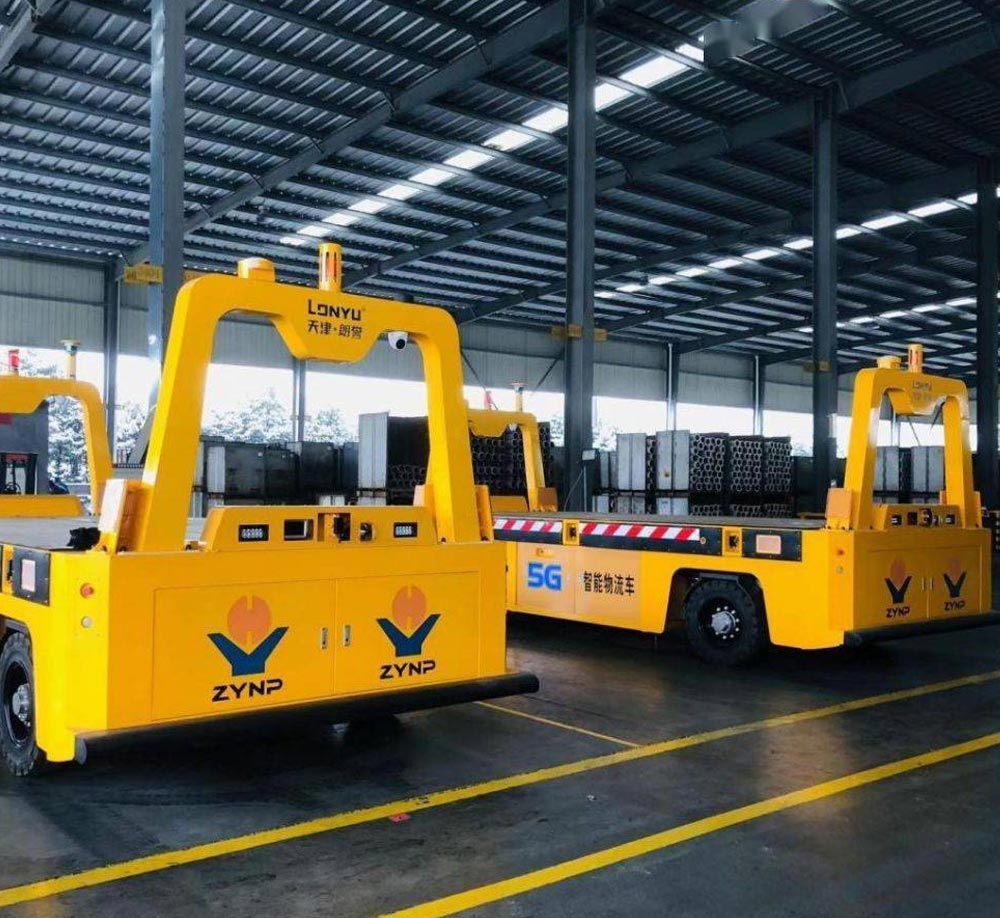
Lonyu Robot’s Automatic Mold Transfer System is designed for automated transportation of molds and racks in defined industrial workflows. The published application describes the transportation of excavator chassis molds in the engineering machinery industry, with a mold buffer area between the smelting area and sand-dropping area.
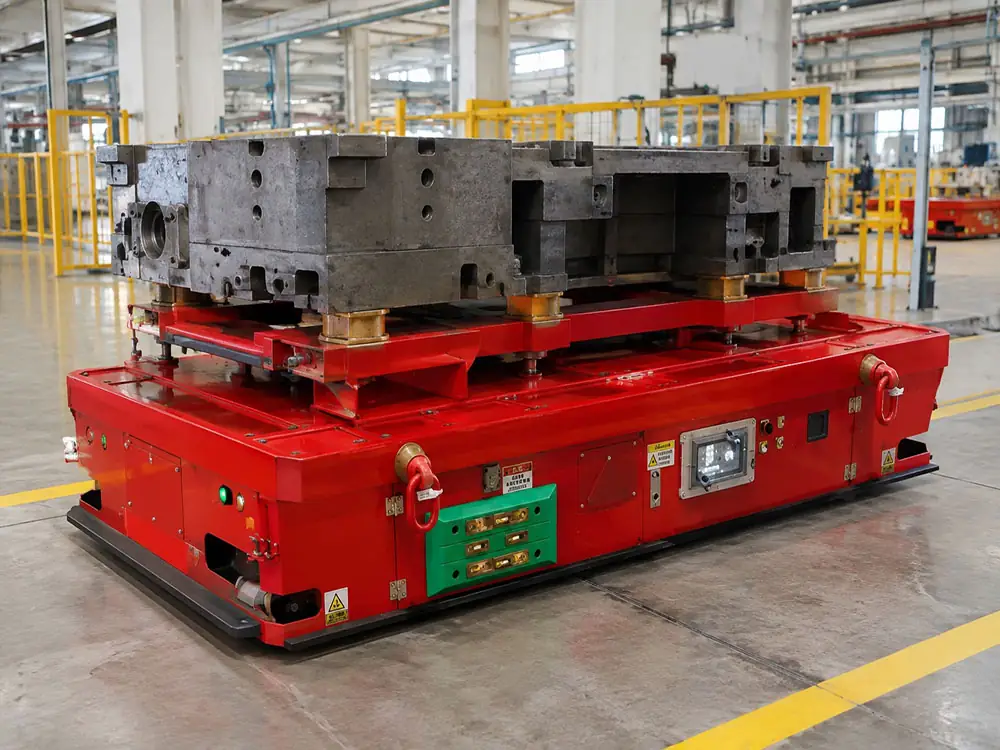
The published configuration has a 10-ton load capacity, a 2.2-ton vehicle weight, and dimensions of 2,580 × 1,600 × 675 mm. It uses a dual-drive structure and hydraulic-cylinder platform lifting. The system can be operated by manual remote control or self-operation.
| 规格 | Published Configuration |
| Load capacity | 10 t |
| Vehicle weight | 2.2 t |
| Vehicle size | 2580 × 1600 × 675 mm |
| Drive structure | Dual drive |
| Drive tonnage | 5 t |
| Lifting method | Hydraulic cylinder platform lift |
| 导航 | Magnetic strip / Laser SLAM / QR code |
| Turning radius | 1500 mm |
| Operation | Manual remote control + self-operation |
| Linkage | Single vehicle |
| Explosion-proof | 不 |
These specifications describe the published configuration and should not be treated as a universal specification for every project. Actual selection should be based on the mold weight, dimensions, rack structure, route, floor conditions, and operating requirements.
How Does the System Handle Mold Transfer?
The system is designed to work with racks that have support legs. The vehicle can enter underneath a compatible rack, lift it from below, and transport the mold. The rack dimensions are matched to the vehicle structure, while hydraulic lifting supports the transfer process.
The published workflow provides a practical example: the vehicle transports the mold between the smelting and sand-dropping areas, with a buffer area positioned between them. After the mold is lifted away, a signal can initiate the return of the pallet toward the smelting area to wait for the next task.
This approach makes the system relevant to repetitive heavy-load workflows where the rack, pickup position, route, and destination can be defined in advance.
Why May It Fit Heavy-Duty Manufacturing Workflows?
The system’s main value is its combination of load capacity, under-rack lifting, and multiple navigation options within one dedicated mold-transfer configuration. The design is not limited to one product type or industry, although the suitability of a particular configuration still depends on the actual application.
常见问题解答
Q1: What are the main automated guided vehicle applications in manufacturing?
A: Common applications include material transportation between workstations, work-in-process movement, tooling transfer, pallet handling, and die or mold transportation. NIST identifies AGVs as part of automated material-handling systems used in manufacturing environments. (National Institute of Standards and Technology)
Q2: What should manufacturers consider when selecting an automatic mold transfer system?
A: The main factors include payload, mold dimensions, load center, rack structure, route, positioning requirements, floor conditions, navigation, safety, operating frequency, and charging requirements. These parameters should be evaluated together rather than selecting a vehicle based only on its rated load.
Q3: Can an automatic mold transfer system replace conventional material handling equipment?
A: Not in every situation. Automated transport is generally better suited to repetitive and predictable workflows, while forklifts, cranes, and other equipment can remain useful for irregular loads, maintenance tasks, or operations outside the automated route.
Q4: What is an automated guided vehicle system best suited for?
A: It is generally most suitable for planned internal transportation where loads repeatedly move between defined locations. The actual suitability depends on the payload, route, facility layout, safety requirements, production cycle, and level of automation required.
结论
Automated die handling is not simply about replacing a manually operated vehicle. The more important objective is to establish a controlled material flow in which molds can be picked up, transported, positioned, delivered, and returned according to the production process.
For manufacturing plants with repetitive heavy-mold transportation requirements, automation can be worth evaluating when the route, load, and production cycle are sufficiently predictable.
Lonyu Robot’s Automatic Mold Transfer System provides one example of a dedicated approach, with a published 10-ton load capacity, hydraulic platform lifting, dual-drive structure, and magnetic strip, laser SLAM, or QR-code navigation options.
If you are looking for a practical solution for automated mold and die handling, contact us to discuss your load requirements, transfer route, and application needs.