

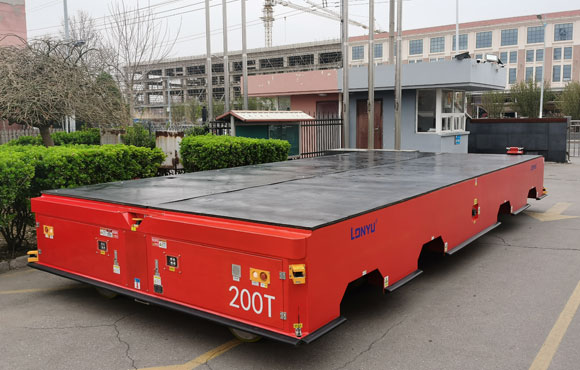
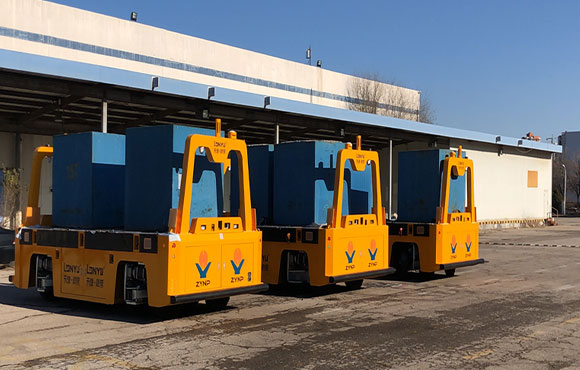
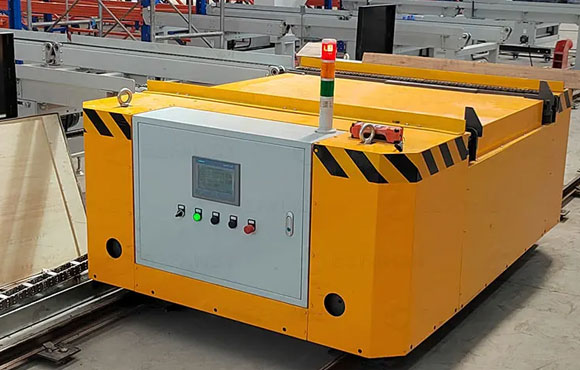
Driven by intelligent manufacturing technology, the global shipbuilding industry is experiencing digital transformation. By 2025, the global smart ship market is expected to exceed $32 billion, and the demand for efficient, safe and flexible logistics solutions is soaring (Source: Maritime Executive). Among various intelligent equipment, heavy duty AGV (Automated Guided Vehicle) has emerged as a core driver, breaking the bottlenecks of traditional material handling in shipyards. This article explores the definition, technical advantages, application scenarios, and development trends of heavy duty AGV in shipbuilding, revealing how this equipment reshapes the industry’s production model.
What is a heavy AGV for shipbuilding Industry?
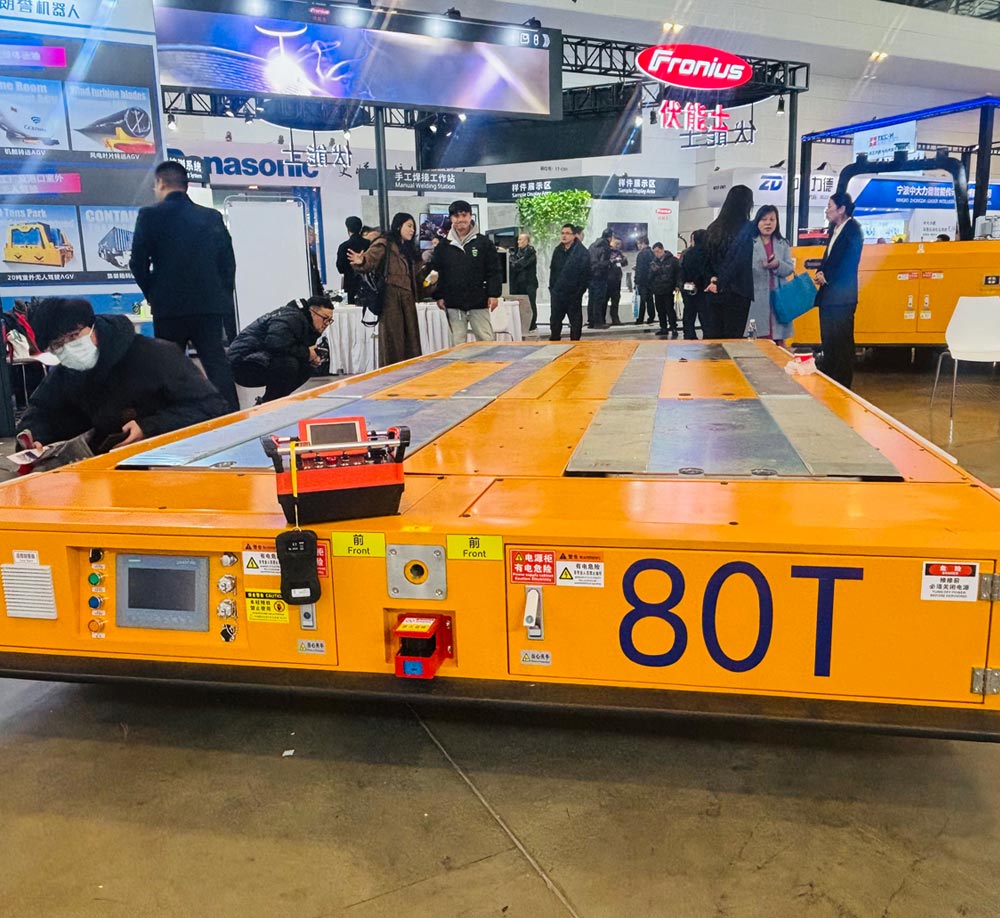
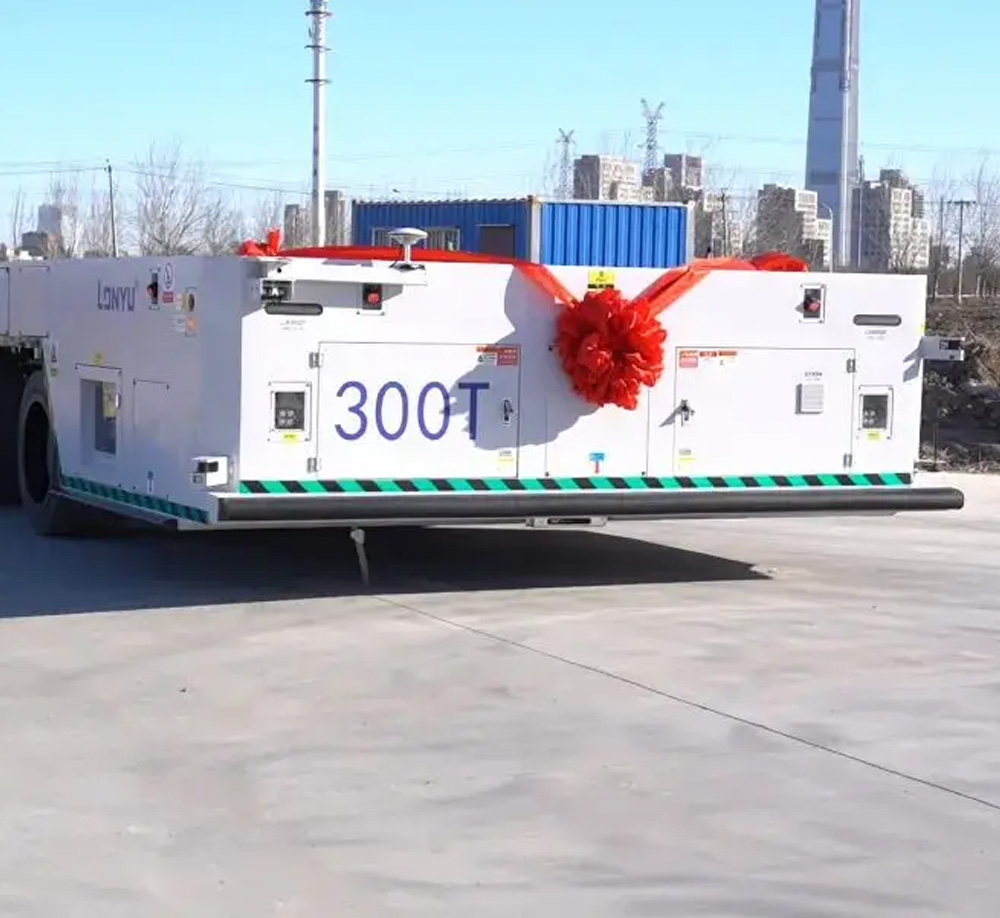
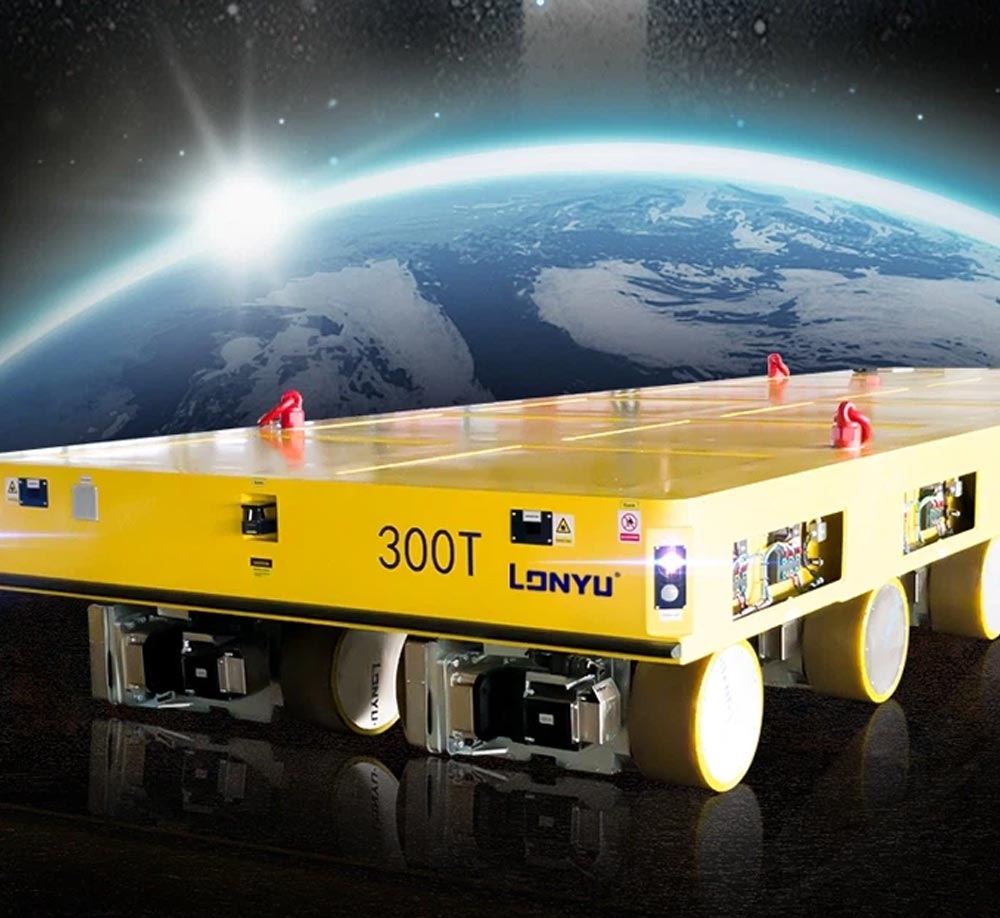
For the shipbuilding industry, a heavy AGV refers to an intelligent device, which is designed to adapt to the shipbuilding scene, with a load capacity of 10 tons or more, and can automatically transporting heavy materials such as hull segments, large molds, steel profiles and outfitting parts. Different from ordinary AGV, heavy duty AGV used in shipbuilding must deal with the unique characteristics of this industry: large product volume, heavy weight of a single piece, diverse varieties, long production cycle and complex operating environment(Source: ISO 6385:2019).
Traditional shipyard material handling mainly relies on gantry crane, track flat cars and manual forklift, which has poor flexibility, low coordination efficiency, high safety risks and large space occupation. It is a key support for the shipbuilding industry to change from labor-intensive to flexible and digital production.
Core technical support system for heavy AGV
The stable operation of heavy duty AGV in shipbuilding field depends on the cooperation of various technologies, and the core technical system covering five modules.
1. Heavy-load bearing and driving system: High-strength steel frame is adopted, combined with multi-motor coordinated driving and large-diameter heavy-load steering wheel, with a single bearing capacity ranges from 10 tons to 50 tons, and multi-vehicle linkage can realize the transportation of 100 ton material. It has the functions of anti-eccentric load and shock absorption, ensuring the smooth transportation of irregular heavy materials.
2. Navigation and positioning System: Laser SLAM, visual navigation and magnetic stripe assisted navigation technologies are integrated, and the positioning accuracy reaches 10 mm, which resists the interference from metal parts in workshops, ground pipelines, ditches and other obstacles, and supports dynamic path planning and flexible steering in narrow spaces.
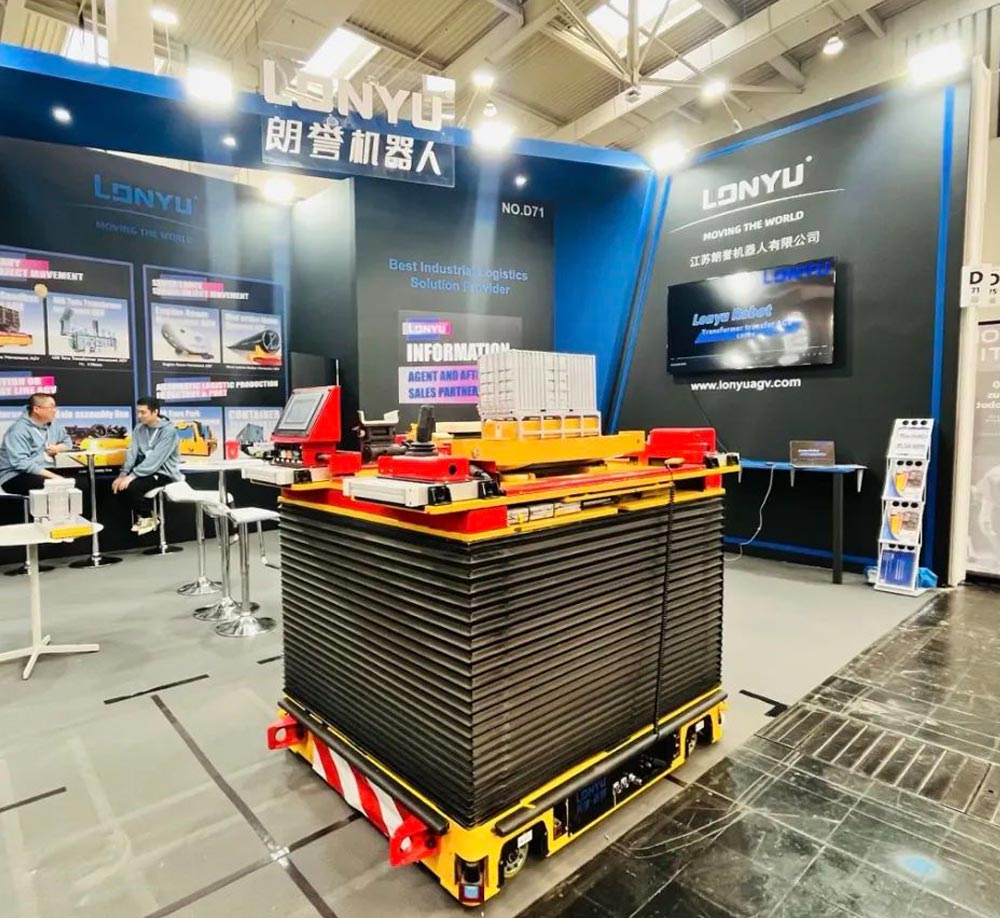
3. Intelligent scheduling control system: Based on 5 edge computing technology, the agv robot system realizes cluster scheduling and real-time task assignment of multiple AGVs. It can be seamlessly connect with MES (Manufacturing Execution System), WMS (Warehouse Management System) and vertical warehouse PLC, forming a closed-loop production line cooperation.
4. Safety Protection System: Equipped with 360 ° laser radar obstacle avoidance, mechanical anti-collision edges, sound and light alarms, and emergency braking modules. Outdoor models are provided with waterproof and dustproof design above IP 65 and high and low temperature resistance at -10℃ ~ 50℃.
5. Adaptive Leveling System: Through hydraulic lifting and horizontal self-test functions, materials are kept horizontal during transportation to avoid deformation or sliding due to uneven force.
Key Specifications of Heavy Duty AGV for Shipbuilding
| Technology Indicator | Core Requirement |
| Loading Capacity | Unit: 10-50 tons; Multi-vehicle linkage: 100 tons or more |
| Location Accuracy | 10 mm .; Accuracy of repeated positioning: 5mm |
| Protective Grade | IP 65 or above (waterproof, dustproof and salt spray corrosion resistant |
| Operating Temperature | -10℃~50℃ |
| Climbing Ability | ≥8° |
| Charged Time | ≤ 2.5 hours; Life of single battery: 8 hours or more |
Core application scenarios and operational processes
Heavy duty AGV is widely used throughout the whole shipbuilding process, mainly focusing on the standardized operation process of three core scenes.
1. Steel/Profile/Outfitting Component Delivery Scenario
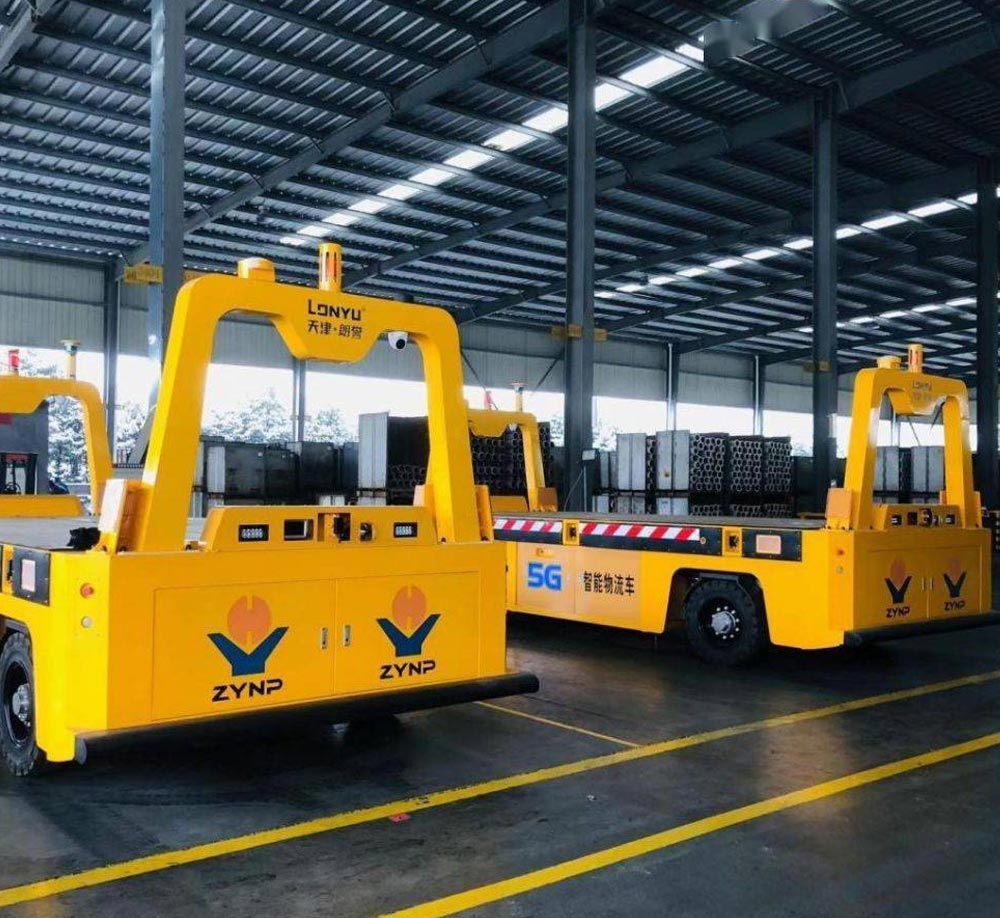
The scene covers the front-end processes of shipbuilding, and automatically transports steel, H-beam, angle steels, pipe fittings and outfitting parts from storage areas and cutting areas to welding areas and sub-assembly stations. The 30 ton Double-vehicle linkage AGV is especially suitable for this situation. Operating process:
- Task Trigger: The MES system issues material delivery instructions based on production plans, and the agv robot system assigns the optimal heavy duty agv.
- Material Loading: The AGV autonomously drives to the storage area, accurately docks with material pallets through hydraulic lifting devices, and fixes materials with self-locking mechanisms.
- Intelligent Transportation: The AGV travels along dynamically planned paths, avoiding obstacles in real-time through laser radar and adjusting driving posture flexibly.
- Precise Delivery: The AGV arrives at the target station, completes centimeter-level positioning, and feeds back delivery completion signals after stably lowering materials.
2. Hull Section Transportation Scenario
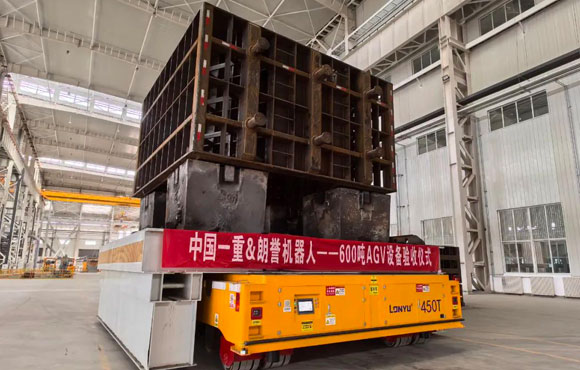
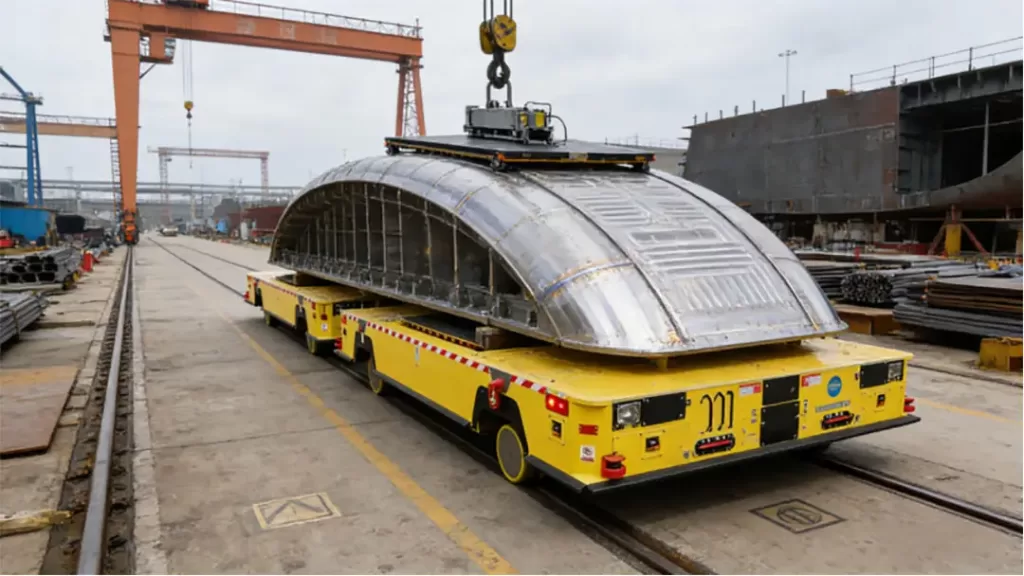
Hull segmentation (bottom, side, deck, etc.) is the core components of shipbuilding, and the weight of a single segment reaches tens of tons. Heavy duty AGV has realized efficient transportation through multi-vehicle linkage technology. Operating process:
- Sectional handover: The bridge crane places the assembled hull on the combined bearing platform of several heavy AGVs, and the AGV adjusts its height through adaptive leveling systems.
- Path Planning: The scheduling system plans optimal paths based on shipyard construction progress and on-site equipment distribution.
- Coordinated transportation: Multiple AGVs are started synchronously, realizing coordinated movements such as straight line driving, diagonal driving and in-situ rotation.
- Accurate docking: AGVs cooperates with measuring equipment to complete accurate alignment, and the positioning error is within 20 mm, and then it is smoothly lowered.
3. Large-scale mold transportation scenario
The large-scale die for forming curved plate of hull requires high precision in the process of transportation. Heavy duty AGV is customized for this situation, with hydraulic locking devices and precise suspension systems to avoid collision and vibration. The outdoor unmanned agv can also be used for large-scale mould transportation in outdoor shipyards.
Core application value of heavy duty AGV
The large-scale application of heavy duty AGV in shipbuilding field has achieved three leaps in core value.
- Safety Efficiency Upgrade: Replaces manual driving and high-altitude hoisting operations, eliminating safety accidents such as heavy objects falling and collisions, and reducing the labor intensity of operators.
- Production Efficiency Improvement: Through 7 × 24 hours continuous operation, dynamic path optimization and multi-equipment cooperation, the handling time of a single production line can be reduced by more than 60%, and the overall production efficiency can be improved by more than 40%.
- Flexibility and digital upgrade: Break the space limitation of traditional rail transportation, meet the needs of multi-ship mixed-line production, and realize the traceability of the whole process data of material transportation.
Development Trends of Heavy Duty AGV
With the deep integration of artificial intelligence, 5 g and digital twin technologies, heavy duty AGV in shipbuilding field will present four major development trends.
- Intelligent independent upgrade: Integrate AI visual recognition and digital twin technology to realize automatic material identification and virtual operation simulation.
- Heavy load and flexibility expansion: Develop to ultra-heavy load (single load exceeding 100 tons), adopt modular design, and adapt to diversified material transportation requirements.
- Green and efficient integration: Adopt high energy density lithium batteries and energy recovery technology, promote battery replacement mode, and realize zero-carbon operation.
- Full-process cooperation: Cooperate with intelligent gantry crane, mechanical arms and unmanned trucks to build a full-process unmanned logistics system.
FAQ About Heavy Duty AGV in Shipbuilding
Q 1: What factors should be considered when choosing a heavy AGV for shipyards?
A 1: Key factors include payload, navigation accuracy, environmental adaptability (waterproof, dustproof and corrosion-resistant), system compatibility with existing MES/WMS, and after-sales service ability of the agv manufacturer.
Q 2: How to reduce the upfront investment cost of heavy AGV?
A 2: Popularize the mode of “equipment leasing+operation and maintenance service” and select agv manufacturers whose core components are localized, so as to reduce manufacturing costs and shorten investment recovery periods.
Q 3: Can heavy AGV adapt to the indoor and outdoor operations of shipyards at the same time?
A 3: Yes, the protection level of outdoor models is ip65+, which is resistant to high and low temperature. Beidou has high-precision positioning, which can realize seamless switching between indoor and outdoor navigation.
Q 4: How to ensure the coordination of several heavy AGVs?
A 4: Relying on the agv robot system based on 5 edge computing, it supports cluster scheduling of more than 50 AGVs and has the functions of task priority allocation and path conflict avoidance.
Summary
As a core equipment of intelligent transformation of the shipbuilding industry, heavy AGV has formed mature application mode in many scenarios. By solving the pain points of traditional transportation, it can provide strong support for shipyards to improve efficiency, reduce costs and ensure safety. Choosing a professional agv manufacturer and an appropriate agv robot system is the key to realizing the intelligent upgrade of shipyard logistics. In the future, heavy AGVs will play a more important role in promoting the development of shipbuilding industry to flexible, digital and green intelligent construction mode.