

Key Takeaways
- Commercial vehicle chassis transfer requires more than sufficient payload capacity. The AGV must support the chassis at suitable positions without interfering with its structure or installed components.
- Support spacing, chassis dimensions, turning clearance, and workstation handover conditions should be checked against actual chassis drawings.
- Navigation and safety arrangements must match the factory route, including narrow aisles, shared work areas, floor conditions, and outdoor sections.
- Before requesting a quotation, prepare chassis dimensions, total carried weight, support requirements, route information, and expected transport frequency.
Introduction
Moving a commercial vehicle chassis between assembly stations is a demanding material-handling task. The load may be long, heavy, and unevenly distributed. Its support points must also match the chassis structure. A heavy duty agv selected only by its rated payload may therefore fail to meet the actual transfer requirements.
For vehicle manufacturers, the key question is whether the AGV can carry the chassis securely, travel through the available route, and deliver it in a suitable position for the next assembly operation. This guide explains the technical details that production engineers and purchasing teams should review before selecting a solution.
What Makes Commercial Vehicle Chassis Transfer Different from General Heavy-Load Transport?
A commercial vehicle chassis is not a compact, uniform load. Its length, axle arrangement, frame structure, and installed components all affect how it can be supported and moved.
How Do Chassis Weight and Axle Spacing Affect AGV Selection?
Total weight is only the starting point. Two chassis with similar weights may have different lengths and axle configurations. Their centers of gravity and load distribution can also vary.
A chassis with a longer wheelbase may require support points spread farther apart. If the supports are too close together, the frame may experience unwanted bending or vibration during movement. Incorrect positioning may also obstruct components that need to be installed at the next workstation.
Before selecting an AGV, obtain the chassis drawing and identify its overall dimensions, front and rear axle positions, approved support areas, and any components extending below or outside the main frame. The center of gravity should also be confirmed when this information is available.
This information helps engineers determine whether the chassis can be carried within the available support area. In agv in manufacturing applications, matching the transport equipment to the workpiece geometry is often just as important as checking the load rating.
Why Does the Support Layout Matter During Chassis Transfer?
A long chassis needs stable support throughout the journey. Supporting it only at convenient points may create excessive local stress or allow the frame to move when the AGV starts, turns, or stops.
The support layout should follow the chassis structure rather than use arbitrary spacing. Contact points should be positioned near suitable structural areas while avoiding suspension components, wiring, pipes, and other parts that could be damaged.
If a production line handles several chassis models, their axle spacing and frame dimensions should be compared. Adjustable support positions may be suitable when the differences are manageable. Larger structural differences may require model-specific support arrangements.
The design should be checked against the chassis drawings before production. A drawing-based review is more reliable than assuming that a chassis will fit simply because its weight and dimensions fall within the AGV’s rated limits.
What Should Be Considered at Assembly Workstation Handover Points?
Transport does not end when the AGV reaches the next station. The chassis must arrive in a position that allows workers, fixtures, or automated equipment to continue the assembly process.
For example, a workstation may require access to the underside of the chassis. A support structure that blocks this area could delay assembly even if the transport itself is successful. If the chassis arrives in an inconsistent position, workers may also need to adjust it manually before starting the next operation.
Production engineers should define the handover position, acceptable alignment tolerance, access requirements, and unloading method for each station. These requirements should be discussed with the supplier before the route and support arrangement are finalized.
How Should Buyers Check Payload, Support Layout, and AGV Dimensions?
The AGV must carry the complete transport load, not just the bare chassis. Its dimensions must also suit the route and the available space around each workstation.
What Payload Capacity Is Required?
Start with the heaviest chassis that will be transported. Then include any fixtures, brackets, temporary attachments, or other items carried at the same time.
The maximum expected transport load is a more suitable design reference than the average chassis weight when production involves several models. Buyers should also ask whether the stated rated load includes the transport fixture or refers only to the carried workpiece.
Load distribution matters as well. A chassis may fall within the rated payload while placing too much weight on one support area or drive unit. The supplier should review both total weight and the positions where the load is applied.
For heavy load transport, payload capacity, load distribution, and support design need to be assessed together. A higher rated payload cannot compensate for an unsuitable support layout.
How Should Support Distance and Contact Points Be Checked?
Compare the chassis drawing with the proposed AGV support layout. The distance between supports should correspond to the front and rear axle arrangement or other approved structural contact positions.
The contact points must rest on suitable frame areas without interfering with pipes, wiring, suspension parts, or other vulnerable components. They should also leave enough clearance for assembly tools and workstation operations.
If one production line handles several chassis types, confirm how the support positions will be adjusted between models. The supplier should explain whether the structure can be repositioned and whether changes require tools, additional fixtures, or production downtime.
Will the AGV Fit Through the Route and Around Each Workstation?
The AGV’s overall length and width affect aisle clearance, turning space, and workstation access. A vehicle may fit through a straight aisle but still struggle at a corner or when approaching a station from the required direction.
Route planning must account for both the AGV and the full load it carries. A long chassis may extend beyond the vehicle body, increasing the space needed during turns. Columns, safety fences, machines, stored materials, and pedestrian walkways can further restrict movement.
Measure the narrowest aisle, turning areas, door openings, and workstation approach zones. Then review the loaded vehicle’s turning envelope with the supplier. A route simulation or on-site trial can help identify interference before installation.
Which Navigation and Operating Conditions Should Buyers Evaluate?
A suitable navigation method depends on the route, factory layout, and level of change expected in daily production. The operating environment also affects floor requirements, safety planning, and maintenance.
Which Navigation Method Fits the Factory Route?
Magnetic stripe navigation can be suitable for routes that remain relatively stable. The magnetic path provides a defined travel reference, which helps organize repeated transfers between fixed workstations.
However, the route needs to be planned before installation. Buyers should identify where the magnetic strips will be placed and whether floor joints, metal structures, crossing points, or future equipment changes could affect the path.
Other navigation technologies may offer greater flexibility when production layouts change frequently, but they involve different infrastructure, positioning, and commissioning requirements. When comparing automated guided vehicle applications, focus on the actual route and the frequency of layout changes rather than assuming that one navigation method suits every factory.
Can the Factory Floor and Outdoor Route Support AGV Operation?
Floor conditions influence traction, stability, and travel consistency. Inspect the route for uneven joints, damaged concrete, drainage channels, ramps, standing water, and transitions between indoor and outdoor surfaces.
A long, heavy load may react differently when the AGV passes over an uneven surface. The engineering review should therefore cover the complete route, not just the floor near the loading point.
For outdoor sections, also review rain exposure, temperature variation, drainage, lighting, and the transition between indoor and outdoor areas. Ask the supplier which environmental conditions the proposed configuration supports and which protective options need to be specified.
What Safety Functions Should Be Confirmed?
The AGV route may cross pedestrian paths, forklift lanes, or areas where workers perform assembly tasks. These interactions need to be addressed in the factory risk assessment.
ISO 3691-4 covers safety requirements and verification for driverless industrial trucks and their systems. ISO 12100 provides a broader framework for machinery risk assessment and risk reduction. These standards can guide the safety review, but buyers should confirm the requirements applicable to the specific equipment and operating environment.
Discuss obstacle detection, emergency stops, audible or visual warnings, speed management, access control, and safe stopping behavior with the supplier. The final safety arrangement should reflect the route layout and the people working around it.
ISO+1
What Information Should Buyers Prepare Before Requesting a Quotation?
A detailed RFQ helps the supplier evaluate the actual transfer task instead of quoting an AGV based on payload alone.
What Should Be Included in the RFQ?
Prepare the chassis drawings, maximum weight, overall dimensions, axle spacing, center of gravity, and approved support locations. The supplier also needs the pickup and unloading positions, workstation handover conditions, and any requirements for accessing the chassis during assembly.
Factory layout drawings should show aisle widths, turning areas, floor conditions, indoor or outdoor sections, and pedestrian or vehicle crossings. Operating information should cover transport frequency, working hours, shift patterns, expected cycle time, and situations that may require manual intervention.
Photos and layout drawings can make the initial review more efficient. If the chassis has several variants, provide drawings for the largest and heaviest models first.
How Should Buyers Review the Quotation and Acceptance Plan?
A quotation should explain more than the AGV model and rated payload. It should identify the proposed support arrangement, navigation method, battery configuration, safety functions, and any site preparation required.
The acceptance plan should define measurable test conditions. These may include carrying the specified chassis, completing the planned route, approaching each workstation, and operating under the agreed production conditions.
For a manufacturing agv purchase, confirm which items are included in the delivery and which require separate factory work. Route installation, magnetic strip placement, commissioning, operator training, and after-sales support should be clearly assigned before the order is placed.
Why Choose Lonyu’s Outdoor Heavy Duty Navigation AGV for Commercial Vehicle Chassis Transfer?
For commercial vehicle assembly lines that need to move chassis between workstations, the proposed AGV configuration should be reviewed against both the chassis structure and the factory route.
The following specifications describe Lonyu’s Outdoor Heavy Duty Navigation AGV, model LK-AK-15T-4-0-B.
| Item | Specification |
| Model | LK-AK-15T-4-0-B |
| Rated load | 15T |
| Product weight | 4T |
| Overall dimensions | 6016 × 1912 × 1011 mm |
| Drive configuration | 4-drive, 8-wheel |
| Navigation | Magnetic stripe navigation |
| Battery | 48V, 500Ah |
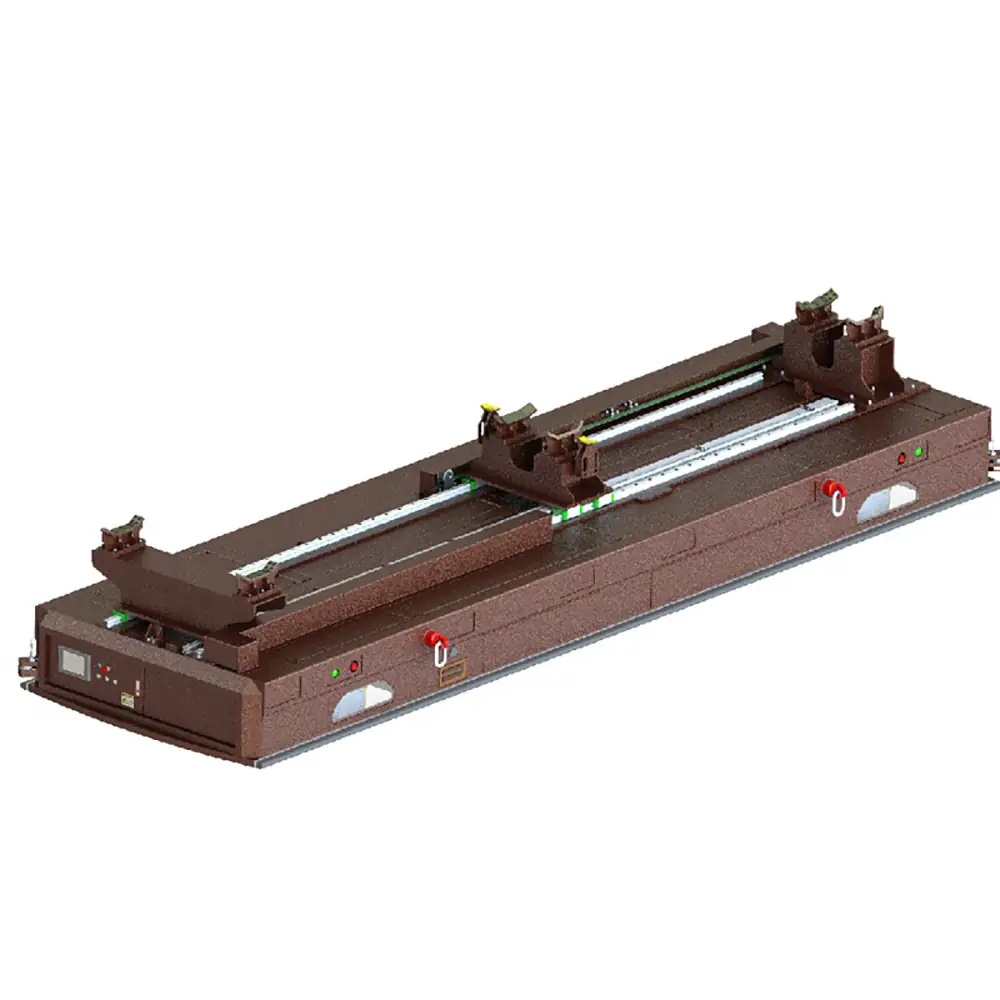
Support Layout Designed Around Chassis Dimensions
The support distance can be adjusted according to the front and rear axle spacing. The number of support points can also be designed according to the chassis axle arrangement.
This is useful when a production line needs to transfer chassis with different structural dimensions. The support layout should still be confirmed against the customer’s drawings to ensure that contact points do not interfere with components or assembly operations.
Four-Drive, Eight-Wheel Configuration
The AGV uses four drive units and eight wheels. This configuration is intended for heavy-load movement between production stations.
During technical review, buyers should confirm the load distribution across the support structure and drive units. The drive unit load weight is specified as 5T; this figure should not be confused with the AGV’s total rated load.
Magnetic Stripe Navigation for Defined Routes
Magnetic stripe navigation provides a defined route for repeated chassis transfers. It can be considered when the production route is stable and the pickup and unloading stations are clearly arranged.
Before installation, the magnetic route should be checked against the factory layout, floor condition, crossing points, and planned equipment locations.
Manual Remote Control and Automatic Operation
The AGV supports both manual remote control and automatic operation. Manual control can be useful during setup, route checks, or operating situations that require operator intervention.
Automatic operation can support repeated transfers along an established route. The operating mode and control procedures should be agreed during commissioning.
Spring Suspension for Load Support
The vehicle uses spring suspension. Its suitability should be assessed in relation to chassis weight distribution, support locations, and floor conditions along the route.
For chassis transfer, the suspension arrangement should be reviewed together with the support design. The aim is to maintain stable contact and avoid unnecessary movement of the carried structure during travel.
The model does not have a lifting function. The chassis must be loaded and unloaded through a separately planned process, such as a suitable workstation fixture or other handling equipment.
Frequently Asked Questions
Does the Lonyu LK-AK-15T-4-0-B AGV have a lifting function?
No. This model does not have a lifting function. The loading and unloading process must be arranged through suitable external equipment or a workstation fixture. Buyers should confirm the required pickup height and handover method before ordering.
Can the support layout accommodate different commercial vehicle chassis models?
The support distance can be adjusted according to front and rear axle spacing, and the number of supports can be designed around the chassis axle arrangement. Compatibility still depends on the actual chassis dimensions, structural contact areas, and component clearances. Drawings for each chassis model should be reviewed before the support layout is finalized.
Can this AGV operate manually as well as automatically?
Yes. The model supports manual remote control and automatic operation. Buyers should clarify when each mode will be used and how operators will manage route checks, commissioning, and exceptional operating conditions.
How much payload capacity does a chassis transfer AGV need?
The required capacity should cover the heaviest chassis together with all fixtures and components carried during transport. Load distribution must also remain within the limits of the AGV’s support and drive configuration. The supplier should review both total weight and the positions where the load is applied.
What should be checked before an AGV travels outdoors?
Review the floor surface, drainage, slopes, transitions between indoor and outdoor areas, weather exposure, and route visibility. Confirm the equipment’s environmental protection requirements with the supplier rather than assuming that every outdoor AGV has the same protection level.
Conclusion
Introducing an AGV into a chassis assembly line is not simply a matter of replacing manual transport. It also affects workstation coordination, production scheduling, route management, and the movement of different chassis models through the factory.
A well-prepared implementation plan should connect the transport process with the assembly sequence. Buyers should identify which stations need to exchange chassis, where temporary waiting positions are available, and how the line will respond if a transport task is delayed. These details help prevent the AGV from becoming a bottleneck after installation.
If you are sourcing an industrial AGV robot for your operation, provide the load dimensions, total carried weight, pickup and unloading requirements, factory layout, planned route, expected transport frequency, and operating conditions. Lonyu can review these requirements, help determine a suitable AGV configuration, and provide a customized quotation.