

Key Takeaways
- Assess the load, its dimensions, support points, and total carried weight before choosing an AGV.
- Check turning clearance, travel paths, floor conditions, and transfer points when planning movement through confined areas.
- Match navigation, battery capacity, and safety functions to the factory layout and operating schedule.
- Confirm the vehicle’s rated payload and mechanical capabilities against the actual transport task.
Introduction
Moving a 16-ton load through a crowded factory is not simply a matter of choosing a vehicle with sufficient capacity. The load may be difficult to maneuver, the available aisle space may be limited, and production equipment can restrict access to pickup and delivery points. A heavy duty agv must therefore be assessed as part of the complete material-handling process, rather than by payload alone.
The most suitable configuration depends on how the load is positioned, where it needs to travel, and how frequently the movement takes place. Understanding these factors early helps reduce layout conflicts, avoid unnecessary vehicle specifications, and make daily transport more predictable.
What Makes Heavy-Load Movement Difficult in Confined Factory Areas?
A heavy load can be challenging even when the vehicle’s rated capacity is adequate. Its dimensions, center of gravity, and support arrangement affect stability and the space required for turning. Meanwhile, narrow aisles, workstations, storage racks, and other moving equipment can limit the available route.
Load Dimensions Matter as Much as Weight
Two loads with the same mass may require different transport arrangements. A compact steel component may fit comfortably within the vehicle’s support area, while a long frame or oversized assembly may extend beyond it. The additional overhang can affect turning clearance and create collision risks near racks, machine enclosures, or pedestrian routes.
Before planning the route, measure the load’s length, width, height, and support footprint. Identify its center of gravity where possible, and check whether the load can be secured against shifting during acceleration, braking, and changes of direction. If the load has uneven contact points or an unusual shape, the carrying arrangement should be reviewed before the vehicle is selected.
The vehicle’s rated payload should not be treated as proof that every load of the same weight can be carried safely. Weight distribution, load geometry, and the design of the supporting structure also matter.
Aisle Width Does Not Tell the Whole Story
A route may appear wide enough on a floor plan but still be difficult to navigate in operation. Corners, columns, fire doors, machine guards, temporary storage, and the space needed to approach a workstation can all affect the actual clearance.
An automated guided vehicle should be assessed along the entire route, including pickup and unloading points. The turning area must accommodate both the vehicle and the carried load, especially when the load extends beyond the chassis. Routes should also account for people, forklifts, emergency access, and areas where the vehicle may need to stop or wait.
Mapping these constraints before installation helps determine whether the proposed route is practical and whether changes to storage positions or transfer points would improve traffic flow.
How Should Buyers Assess Movement and Navigation Requirements?
Once the load and route are understood, the next step is to assess how the vehicle will move between operating points. The required movement pattern, navigation method, and floor conditions should work together rather than be evaluated separately.
Turning Performance and Direction of Travel
Traditional vehicles may need additional room to turn around or reposition. In a confined production area, repeated maneuvering can slow material flow and complicate movements near equipment. A vehicle capable of moving in multiple directions may be useful where the route includes tight corners, lateral alignment, or limited turning space.
However, omnidirectional movement does not eliminate the need for route planning. The vehicle’s dimensions, turning characteristics, load overhang, and approach angle still determine whether it can reach a transfer point without obstruction. Buyers should review these details using the actual factory layout rather than relying on a turning-radius figure alone.
Navigation Must Suit the Factory Environment
Navigation requirements depend on the layout, traffic conditions, and the level of route flexibility needed. A magnetic-strip system can provide a defined path, which may suit facilities where transport routes are stable and repeatable. If production lines or storage arrangements change frequently, the cost and effort of modifying the route should also be considered.
The operating environment matters as well. Floor joints, uneven surfaces, dust, moisture, and changes in lighting or surrounding equipment can influence overall reliability, depending on the vehicle’s sensors and navigation design. Confirm the permitted floor conditions and installation requirements with the supplier before deployment.
Transport Frequency and Battery Capacity
Battery capacity should be assessed against the expected duty cycle, not just the number of trips in a typical hour. Travel distance, carried weight, waiting time, charging opportunities, and the number of operating shifts all affect energy demand.
A battery that is adequate for occasional transfers may not support continuous production without planned charging. Buyers should estimate daily travel distance and operating hours, then confirm expected endurance and charging arrangements with the supplier. If customized battery capacity is available, it should be evaluated alongside charging time, installation space, and maintenance requirements.
Why Choose Lonyu’s 16-Ton Omnidirectional AGV?
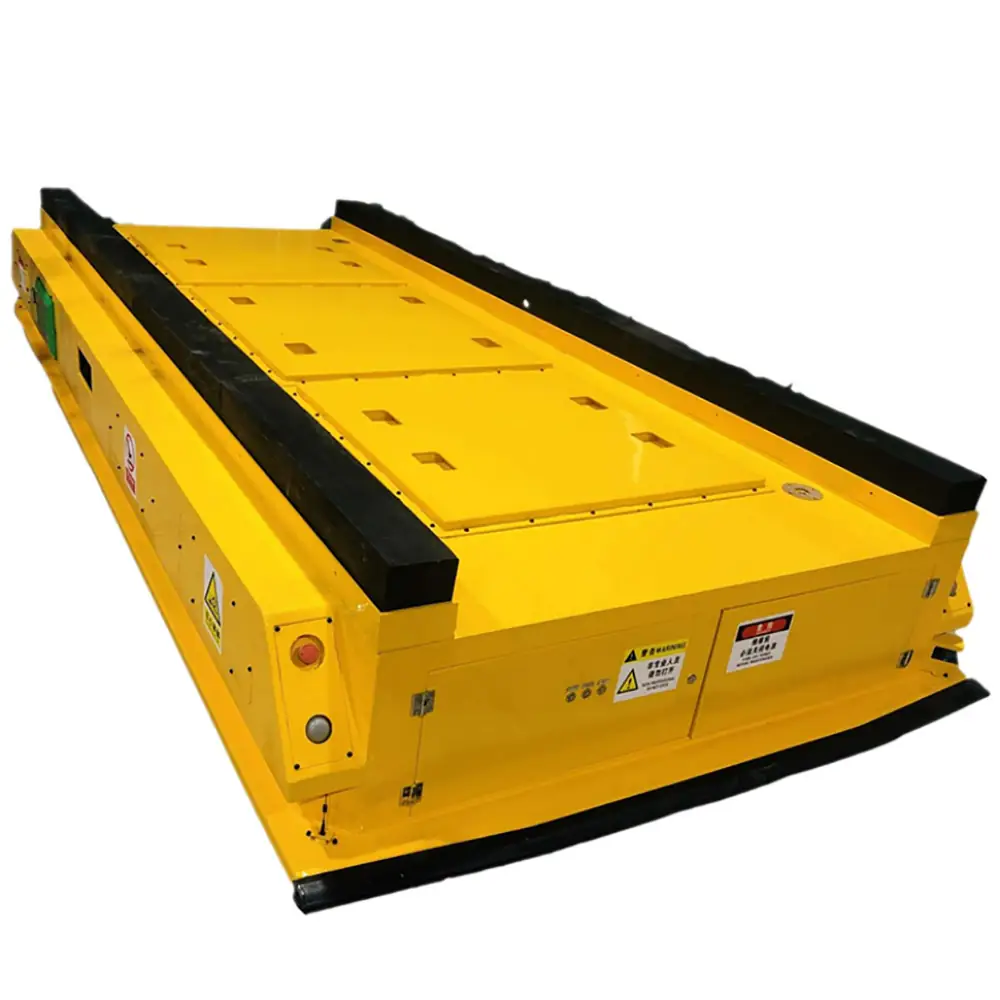
For factories handling loads of up to 16 tons in space-constrained areas, the Lonyu LY-AK-16T-2-4A offers a specific configuration to consider. Its rated load, compact vehicle profile, turning radius, and navigation method provide useful starting points for assessing its fit with the intended transport route.
| Specification | Published information |
| Model | LY-AK-16T-2-4A |
| Rated load | 16,000 kg |
| Vehicle weight | 3,500 kg |
| Overall dimensions | 4,000 × 2,000 × 550 mm |
| Turning radius | 1,125 mm |
| Navigation | Magnetic strip |
| Battery | 48 V, 300 Ah; customized capacity available |
| Drive configuration | Two drive units, four wheels |
A Compact Profile for Heavy-Load Transport
The listed dimensions of 4,000 × 2,000 × 550 mm give buyers a clear starting point for layout checks. The vehicle’s overall footprint should be compared with the load’s support area, aisle width, and space available at each transfer point. Since the load may extend beyond the chassis, the clearance calculation should include the full carried assembly rather than the vehicle body alone.
The rated load is 16,000 kg, while the vehicle itself weighs 3,500 kg. These are separate figures and should be used for different checks: payload capacity for the cargo, and total floor loading for the vehicle carrying that cargo. Actual floor suitability depends on the vehicle’s wheel-load distribution and the facility’s floor specifications.
Omnidirectional Movement in Restricted Areas
The omnidirectional design is relevant to factories where space for turning is limited or where the vehicle needs to align with a load from different directions. The listed turning radius is 1,125 mm, but buyers should verify the measurement basis and test the proposed approach path against the real load dimensions.
A turning-radius value alone cannot confirm that the vehicle will pass through every corner. The carried load, safety clearance, nearby machinery, and the vehicle’s movement envelope all affect access. A layout review using measured aisle and transfer-point dimensions can help identify potential obstructions before installation.
Magnetic Navigation and Battery Configuration
The listed navigation method is magnetic strip, which may suit facilities with established, repeatable routes. Buyers should confirm the required strip layout, installation conditions, route changes, and integration with existing traffic-management arrangements.
The standard battery specification is 48 V and 300 Ah, with customized capacity available. Whether this is sufficient depends on the distance traveled, load, operating hours, and charging schedule. Request duty-cycle information based on the intended application instead of assuming that nominal battery capacity guarantees a particular runtime.
Frequently Asked Questions
Can the Lonyu 16-ton model lift a load from the floor?
No. The published specification lists its lifting ability as “No.” It should be evaluated for transporting a load that has been positioned on it through a suitable loading arrangement, not as a vehicle that can lift cargo from floor level.
Is the 1,125 mm turning radius sufficient for a narrow factory aisle?
Not by itself. Buyers should compare the turning radius with the vehicle’s full dimensions, load overhang, aisle width, corner geometry, and required safety clearance. A route review using the actual carried load is more reliable than judging clearance from one specification.
Can the standard 48 V, 300 Ah battery support continuous operation?
That depends on the duty cycle, including travel distance, cargo weight, operating hours, waiting periods, and charging opportunities. Ask the supplier to estimate runtime for the planned application and confirm whether a customized battery configuration is appropriate.
What information should buyers prepare before requesting a quotation?
Provide the load’s weight and dimensions, support points, pickup and unloading heights, factory layout, aisle measurements, daily travel distance, operating hours, floor conditions, and any relevant safety requirements. These details help the supplier assess whether the vehicle configuration fits the task.
What should be checked before deploying an AGV in an operating factory?
Review the route for obstructions and pedestrian interaction, confirm floor suitability and loading arrangements, and test the transfer sequence at each operating point. The installation plan should also define charging locations, emergency stops, traffic rules, and responsibilities for routine inspection.
Conclusion
Successful heavy-load transport depends on more than vehicle capacity. The load must fit the carrying arrangement, the route must accommodate the complete vehicle-load combination, and the operating schedule must align with battery performance and charging availability. These checks are especially important when planning heavy load transport through shared production areas, where unexpected stops can affect other operations.
When comparing an agv mobile robot for industrial use, consider the full handling sequence, from loading and route entry to alignment, unloading, and return travel. A configuration that suits one part of the route may still create delays at a transfer point or in a shared aisle.
For buyers evaluating an industrial agv robot, Lonyu’s 16-ton model can serve as a reference for discussing payload, dimensions, magnetic navigation, and battery options. Share the load dimensions and weight, factory layout, route measurements, loading method, operating hours, and floor requirements to request a configuration review and quotation.