

Key Takeaways
Energy storage containers require stable, controlled, and repeatable transportation because of their large size and high payload.
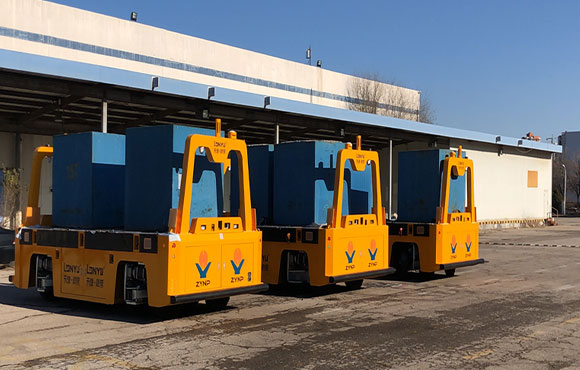
A heavy duty agv can combine high load capacity with automated navigation and controlled movement for industrial logistics.
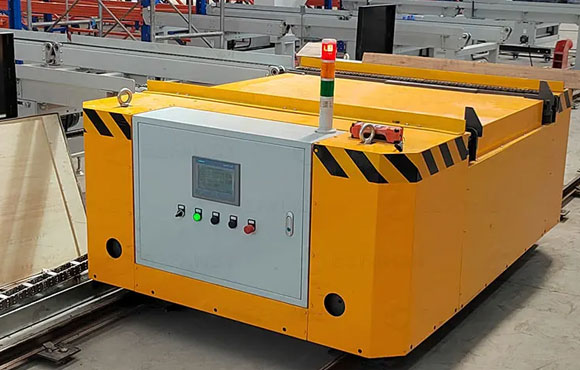
An agv transfer cart can provide a flexible alternative to fixed rail transport when factory routes need to change.
Heavy-load projects should be evaluated according to payload, load distribution, floor conditions, navigation accuracy, braking, battery capacity, and safety requirements.
An 80-ton-class solution is suitable for energy storage container handling when the actual load, route, and factory conditions match the vehicle’s rated specifications.
Why Energy Storage Container Handling Requires Heavy-Duty Transport
Energy storage containers are increasingly used in large-scale battery energy storage systems, but moving these units inside a manufacturing or staging facility can present a different challenge from ordinary warehouse transportation. The load may be large, heavy, and difficult to position with conventional equipment.
Mobility alone is not enough—stability during motion is equally critical. The system’s acceleration, braking, steering, and positioning must all perform reliably and predictably. In addition, ground load capacity, material arrangement, passage width, and center‑of‑gravity positioning are the fine‑grained factors that will decide whether the equipment is fit for purpose.
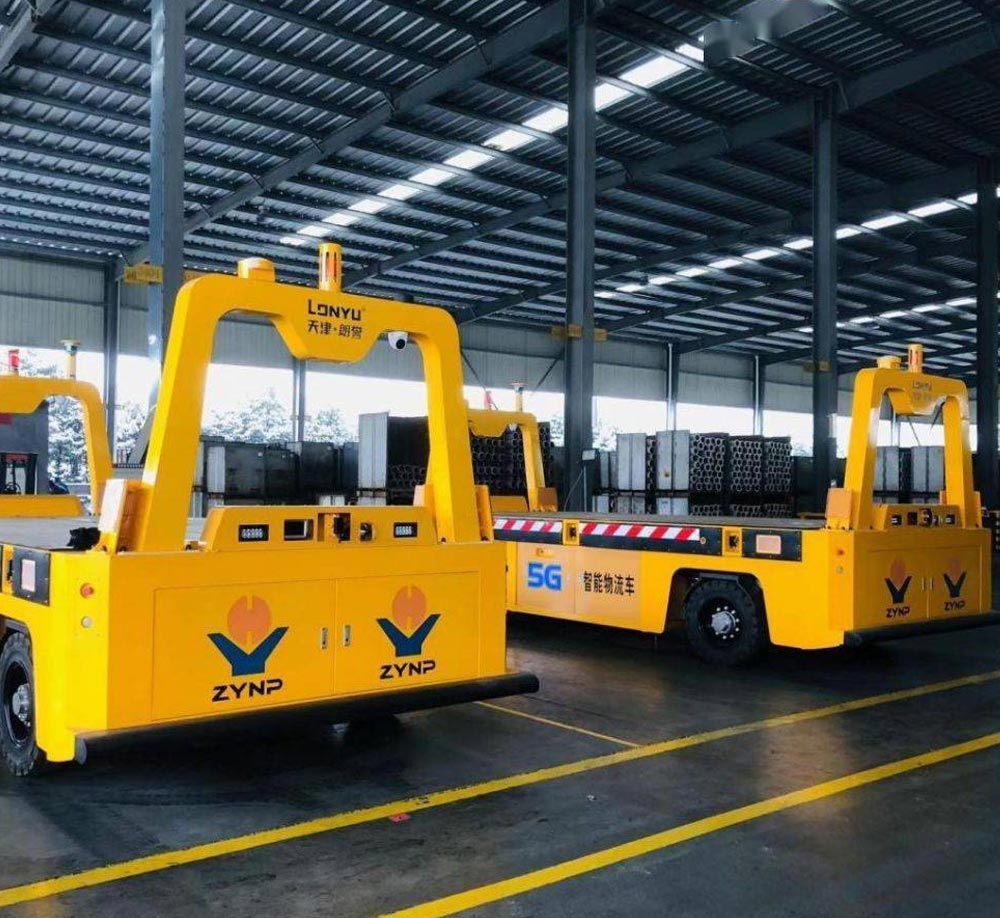
A heavy duty agv is designed for applications where conventional warehouse AGVs may not provide sufficient payload capacity. Instead of focusing mainly on pallet movement, heavy-duty platforms are developed around high-load chassis structures, multiple wheel assemblies, controlled driving systems, and industrial safety functions.This approach can be useful for energy storage manufacturing because containers may need to move repeatedly between production, assembly, testing, staging, and storage areas.
Energy storage containers are not simply oversized loads. Their handling process also needs to account for load stability, controlled movement, and safe operation around battery-related equipment. The U.S. Department of Energy includes transportation-related considerations in its overview of safety-related codes and standards for energy storage systems. This reinforces the need to evaluate the transport vehicle as part of the overall handling process.
What to Consider When Selecting Equipment for Heavy Load Transportation
Selecting equipment for an energy storage container starts with the actual operating conditions.
Payload and Load Distribution
The first step is to confirm the gross load, dimensions, center of gravity, and possible load offsets. An unevenly distributed container can place more stress on individual wheels than a centered load of the same total weight.
This principle also applies to conventional industrial trucks. OSHA notes that load weight, size, position, balance, and stability all affect safe load handling. The same engineering principle should be considered when specifying an automated heavy-load vehicle (OSHA).
For a heavy-load project, buyers should confirm:
- Rated payload and vehicle self-weight
- Container dimensions and center of gravity
- Wheel arrangement and floor loading
- Turning radius and available route width
- Required operating speed and duty cycle
Floor Conditions and Wheel Loading
A heavy vehicle transfers significant forces to the factory floor through its wheels. Therefore, floor strength and condition should be assessed before commissioning.
The evaluation should include concrete strength, reinforcement, surface condition, flatness, expansion joints, ramps, and local floor-loading limits. OSHA also advises that industrial vehicle operating surfaces must be capable of supporting the vehicle and its load.
Wheel material and configuration should be selected according to the floor and operating environment. The objective is not simply to maximize wheel strength, but to achieve an appropriate balance between load capacity, traction, wear, and floor protection.
Steering, Braking, and Stability
Heavy-load movement requires controlled acceleration and deceleration. Excessive speed or abrupt steering can affect load stability, particularly when the transported container has a high center of gravity.
Braking performance should therefore be evaluated under both loaded and unloaded conditions. Buyers should also consider emergency stopping, slope operation, turning behavior, and the interaction between the drive system and the load.
Navigation and Automation in Energy Storage Logistics
Navigation Methods
The navigation method should match the factory layout and environmental conditions. Laser navigation, magnetic guidance, SLAM-based systems, and hybrid approaches can all be used in industrial AGV projects, but their suitability depends on the route, positioning requirements, surrounding equipment, and infrastructure.
For a changing production environment, flexible navigation can reduce dependence on permanent tracks. This can be particularly useful when production lines or temporary storage areas are frequently rearranged.
Positioning Accuracy
Heavy containers do not necessarily require the same positioning accuracy as small components. The required tolerance depends on the task.
For simple point-to-point transportation, reaching the designated unloading area may be sufficient. If the vehicle needs to align with a production platform, lifting mechanism, or other equipment, additional positioning or alignment functions may be required.
Safety and Obstacle Detection
Automation does not eliminate the need for safety planning. A heavy automated vehicle should be evaluated together with pedestrian routes, other vehicles, fixed structures, emergency procedures, and operating zones.
Common safety functions may include obstacle detection, collision avoidance, audible and visual warnings, emergency stops, and controlled travel speeds.
For industrial environments, safety should be designed around the complete application.
Battery and Charging
Battery capacity should be matched to route length, payload, operating frequency, and charging opportunities. A vehicle that operates continuously on a production route may require a different charging strategy from one that performs only several transport cycles per shift.
Opportunity charging and automatic charging can help reduce downtime, but the actual configuration should be determined from the site’s duty cycle and electrical conditions.
Why an AGV Transfer Cart Fits Heavy Energy Storage Logistics
A conventional transfer cart generally provides a platform for moving heavy materials between designated locations. When automated navigation and control are added, the system can become part of a more flexible factory transportation process.
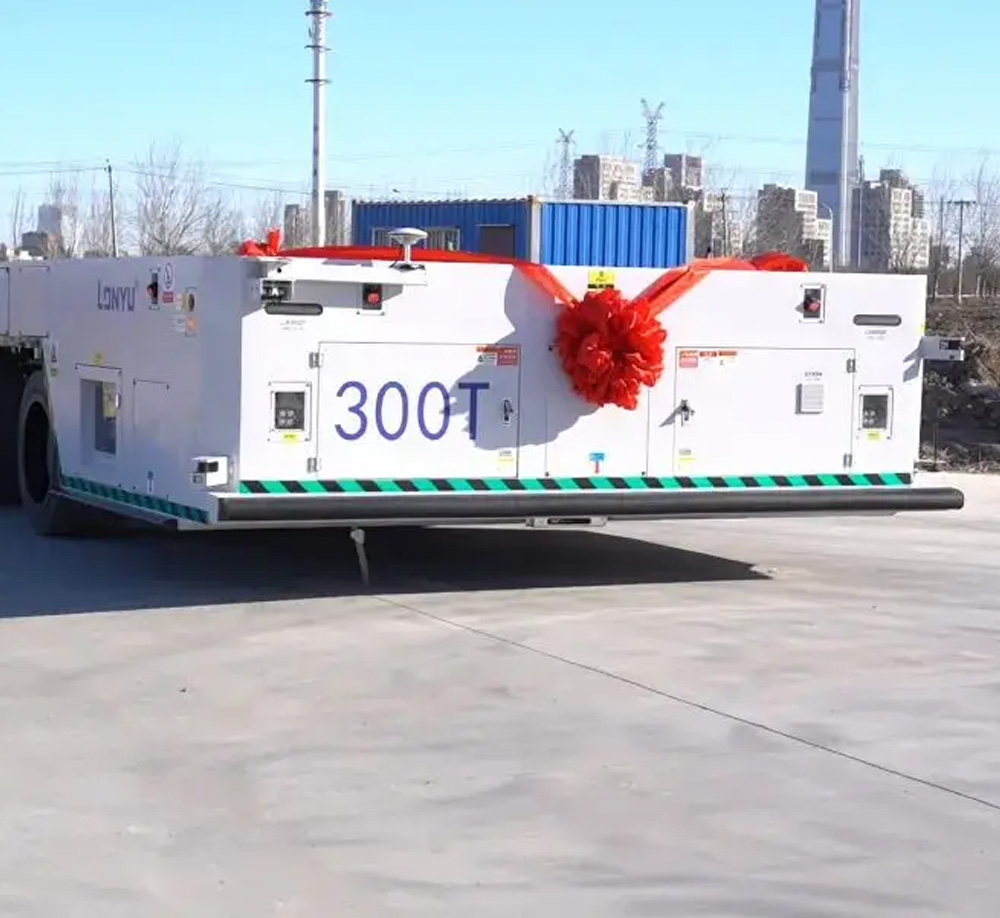
An agv transfer cart can be particularly useful when the factory needs to move heavy containers along multiple routes without installing permanent rails.
Trackless Transportation
A trackless design can reduce dependence on fixed transportation paths. This gives factories more flexibility when production areas, storage locations, or internal logistics routes change.
However, trackless operation does not mean that floor conditions are unimportant. The route still needs to provide sufficient load-bearing capacity, adequate width, suitable surface conditions, and safe clearance.
Comparison With Other Heavy-Load Solutions
| Transport solution | Main strength | Typical limitation |
| Overhead crane | High lifting capability | Fixed lifting coverage |
| Forklift | Flexible point-to-point handling | Payload, visibility, and operator requirements |
| Rail transfer cart | Stable heavy-load movement | Fixed route infrastructure |
| AGV transfer cart | Automated and flexible transportation | Requires route and system planning |
An automated transfer platform is most valuable when repetitive heavy-load movement is an important part of the workflow.
A Practical Selection Process
A practical project can follow four steps:
- Define the load: Confirm weight, dimensions, center of gravity, and loading method.
- Survey the route: Check floor capacity, width, slopes, turning areas, obstacles, and indoor/outdoor transitions.
- Define automation requirements: Specify navigation, positioning, control, charging, and safety functions.
- Match the vehicle: Select the payload, chassis, drive system, battery, and navigation configuration according to the application.
80 Ton AGV for Energy Storage Container Handling
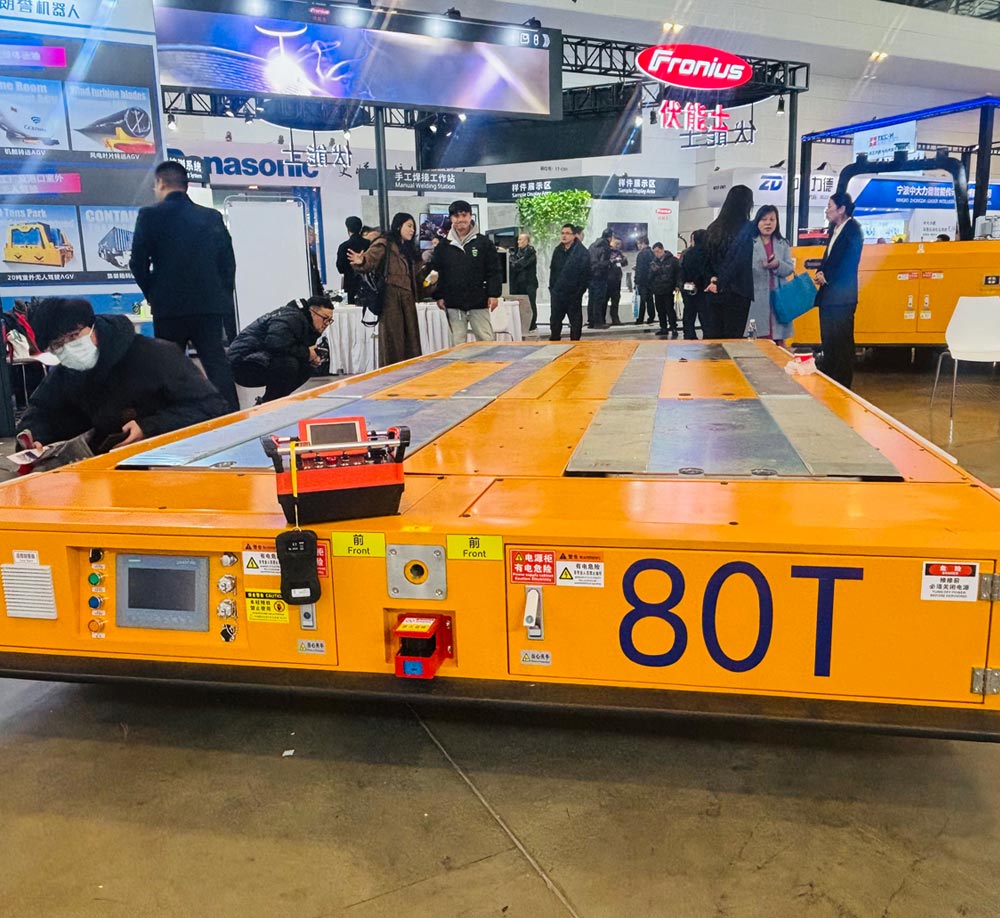
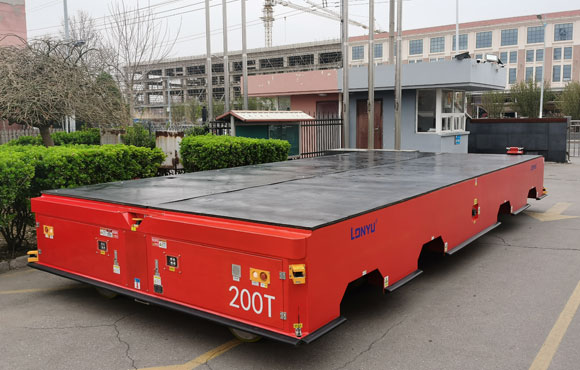
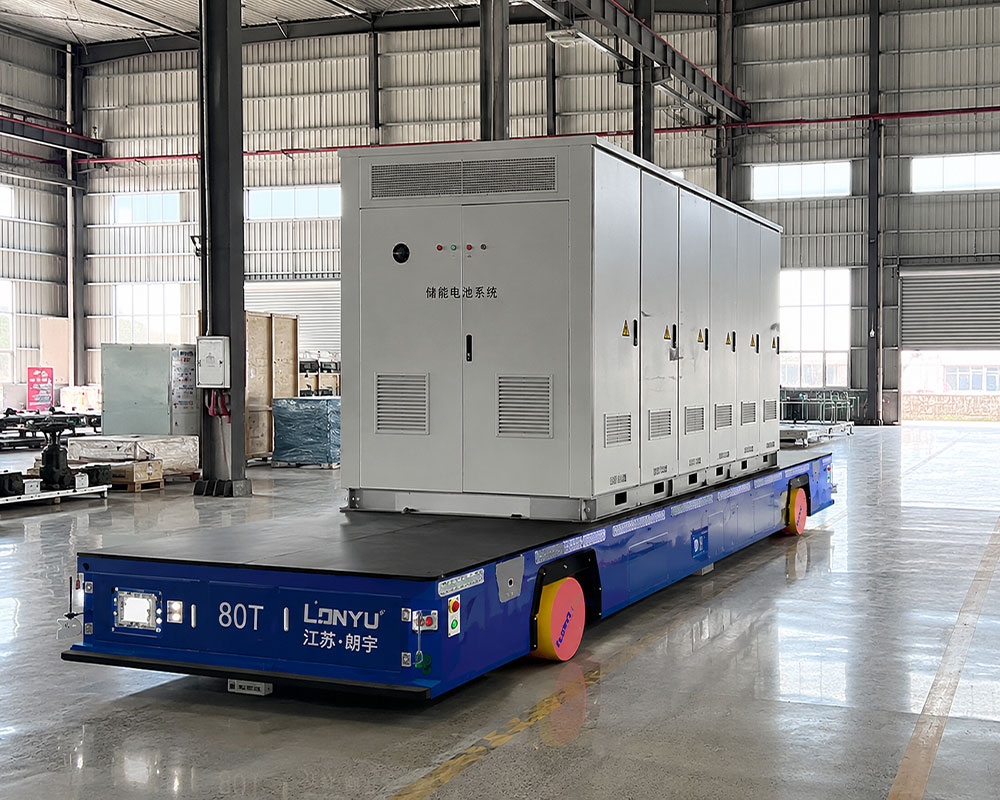
For projects that require high-capacity automated transportation, Lonyu offers an 80-ton trackless AGV transfer cart specifically listed for energy storage container handling.
The model has a rated load of 80 tons and a vehicle weight of 12 tons. Its maximum dimensions are 8,000 × 2,520 × 670 mm, giving the platform a low-profile configuration for heavy material transportation.
| Specification | Lonyu 80 Ton AGV |
| Model | 24391A |
| Rated load | 80 tons |
| Vehicle weight | 12 tons |
| Maximum dimensions | 8,000 × 2,520 × 670 mm |
| Lifting stroke | 200 mm |
| Gradeability | ≤3° |
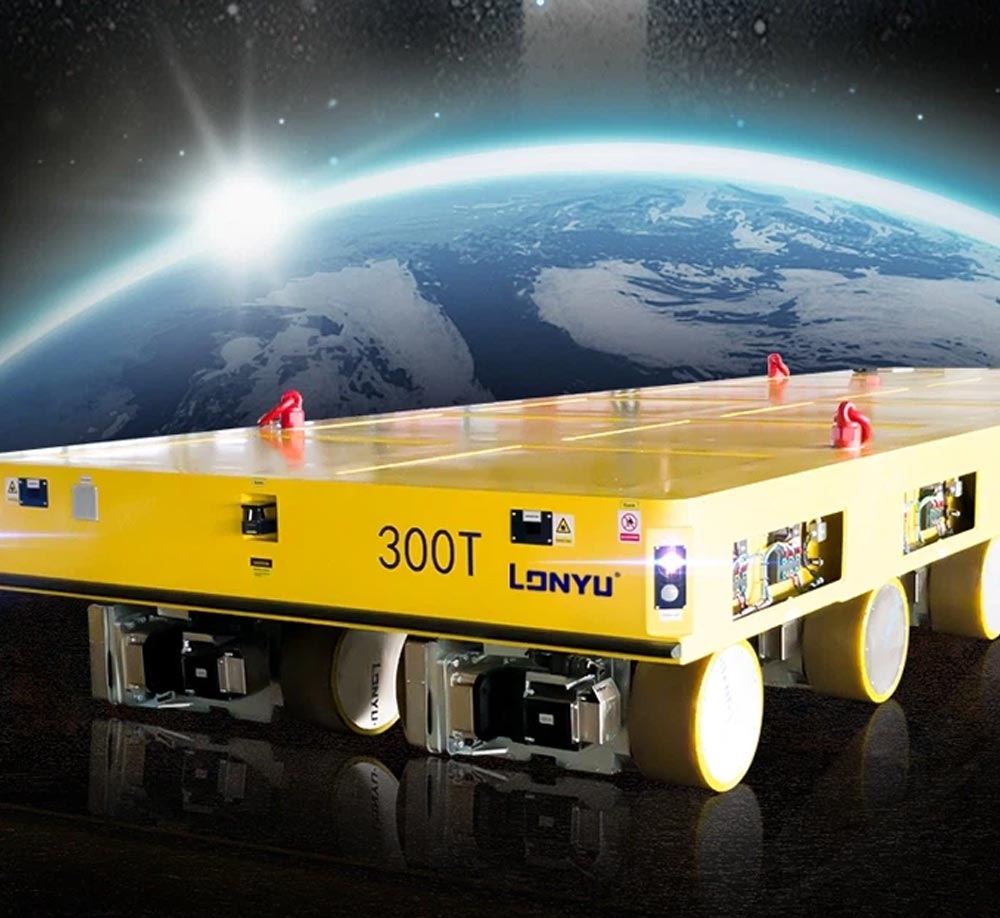
| Drive configuration | Four-wheel drive, eight wheels |
| Suspension | Hydraulic suspension |
| Travel speed | 25 m/min unloaded and fully loaded |
| Battery | Lithium iron phosphate |
| Navigation | Laser navigation + magnetic stripe |
| Navigation accuracy | ±30 mm |
| Positioning accuracy | ±10 mm |
| Protection level | IP54 |
| Application | Energy storage container handling |
The vehicle uses a low-voltage servo motor with an independent servo controller and hydraulic suspension. It supports forward, reverse, left, and right movement. The manufacturer specifies a fully loaded braking distance of no more than 400 mm and an unloaded braking distance of no more than 300 mm.
Its navigation system combines laser navigation with magnetic stripes. The listed safety functions include laser obstacle avoidance, contact collision avoidance, audible and visual warnings, and emergency stop functions.
The battery system uses lithium iron phosphate technology. The listed operating time is approximately three hours under both unloaded and fully loaded conditions, while charging can be performed through automatic side charging or manual charging.
These specifications make the vehicle relevant to heavy energy storage container transport where a factory needs a high-payload, trackless platform.
Before ordering, however, buyers should still confirm the actual container weight, dimensions, floor conditions, route geometry, charging schedule, required positioning accuracy, and interface requirements. The 80-ton rating should be treated as a design parameter, not as a substitute for application-specific engineering.
FAQ
Q1: What is an 80-ton AGV used for?
A: An 80-ton AGV is designed for automated transportation of very heavy industrial loads. In the Lonyu application discussed here, it is specifically listed for energy storage container handling.
Q2: What is the difference between an AGV and an AGV transfer cart?
A: An AGV emphasizes automated guided movement, while an AGV transfer cart combines this automated movement with a heavy-load transfer platform. The latter is particularly suitable when large materials need to be transported horizontally between factory areas.
Q3: What should be checked before using a heavy-load AGV?
A: Buyers should check payload, load distribution, floor capacity, route width, turning radius, slopes, navigation requirements, braking, charging, and safety conditions before finalizing the vehicle configuration.
Q4: Can the Lonyu 80-ton AGV operate indoors and outdoors?
A: The product specification lists both indoor and outdoor operation. It also specifies an IP54 protection level. The actual suitability of an outdoor route should still be evaluated according to local weather, surface, drainage, and operating conditions.
Q5: What navigation system does the 80-ton AGV use?
A: The vehicle uses laser navigation combined with magnetic stripes. The listed navigation accuracy is ±30 mm, while positioning accuracy is ±10 mm.
Conclusion
Heavy energy storage containers require a transportation method that considers payload, stability, floor conditions, navigation, safety, and operating efficiency together. A well-configured heavy load transportation system can help manufacturers move large containers more consistently between production and staging areas.
For applications that require an 80-ton payload and trackless automated movement, Lonyu’s 80-ton AGV transfer cart provides a defined technical configuration for energy storage container handling.
If you are planning a similar project, contact us with your load weight, container dimensions, route conditions, and required workflow to discuss a suitable AGV configuration.