

With the rapid advancement of Industry 4.0, intelligent manufacturing is the core of industrial transformation, and heavy-duty material handling, a key link in factory logistics, faces growing demands for efficiency, intelligence and flexibility. Traditional manual and semi-automatic handling methods can no longer meet the needs of large tonnage, high frequency and complexity in modern factories. Industrial AGVs are a core solution for heavy-duty material handling, offering unmanned operation, high load capacity, and stable performance. However, the navigation system is the “brain” of a heavy-duty AGV and directly determines its adaptability, efficiency, and maintenance costs. Choosing the correct navigation technology is very important for factory decision makers to upgrade heavy handling.
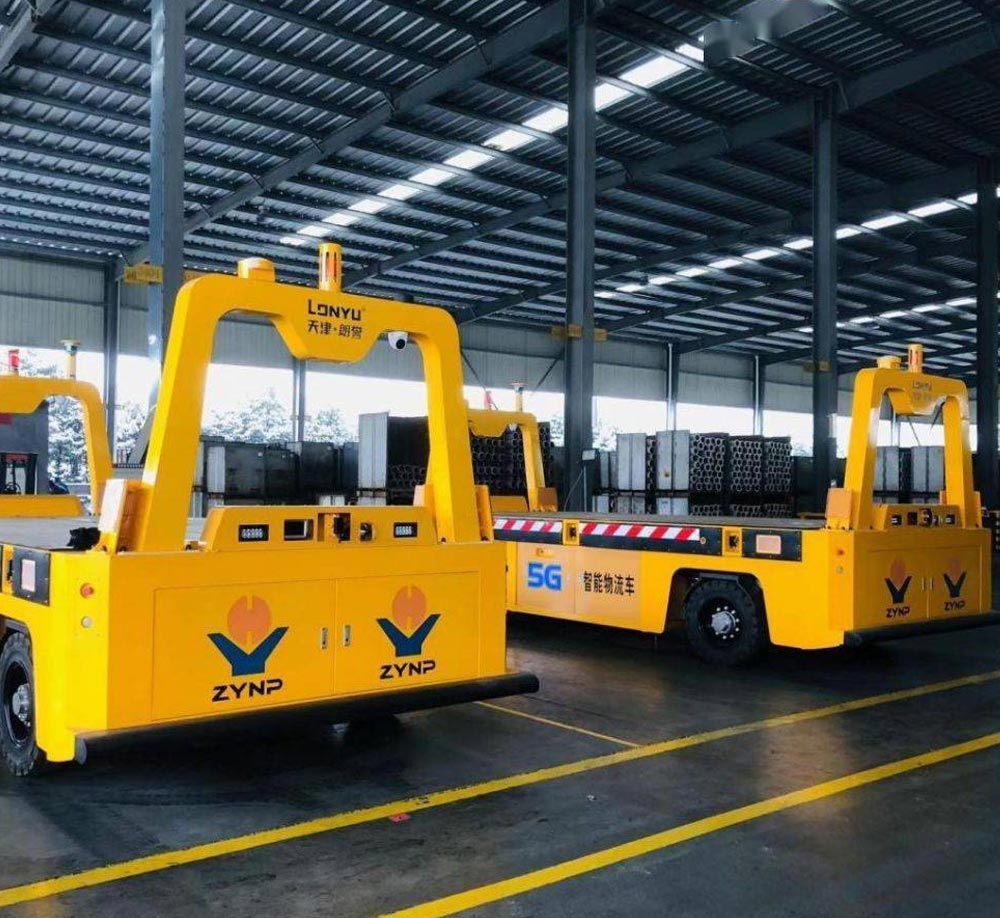
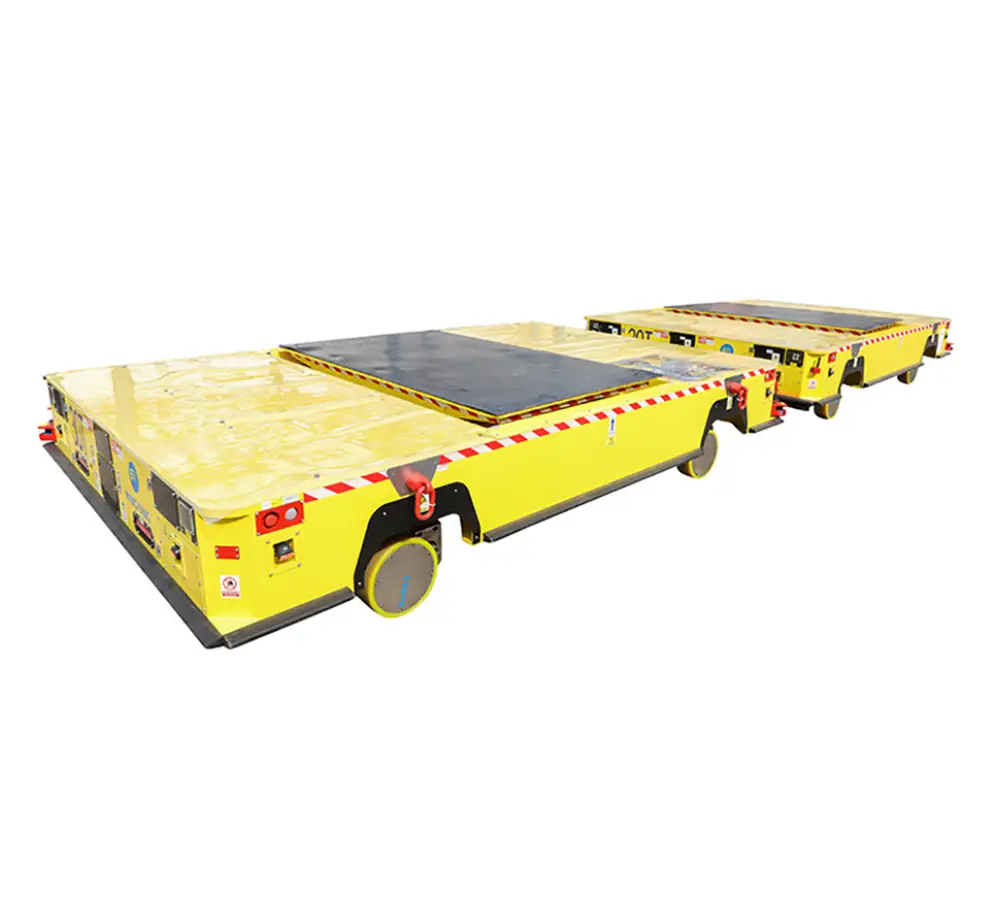
Tianjin LONYU Robot Co., Ltd. is a professional AGV manufacturer, with more than 15 years of experience in R&D and production of heavy-duty AGV, focuses on heavy intelligent logistics. Its core products include 60-ton /80-ton /200-ton trackless transfer vehicles, outdoor unmanned AGV flatbed trucks, 150-ton heavy-duty AGV and automatic mold transfer systems, all of which adopt customized navigation technologies. This guide analyzes the three core navigation technologies for heavy-duty AGVs—magnetic, QR code and SLAM—compares their principles and pros and cons, provides scenario-based guidance, and introduces LONYU’s customized solutions to help factories achieve “cost reduction and efficiency improvement”.
1. The Three Core Navigation Technologies for Heavy-Duty AGVs: Principles and In-Depth Analysis
1.1 Magnetic Navigation: The Classic Low-Cost Option with Fixed Paths
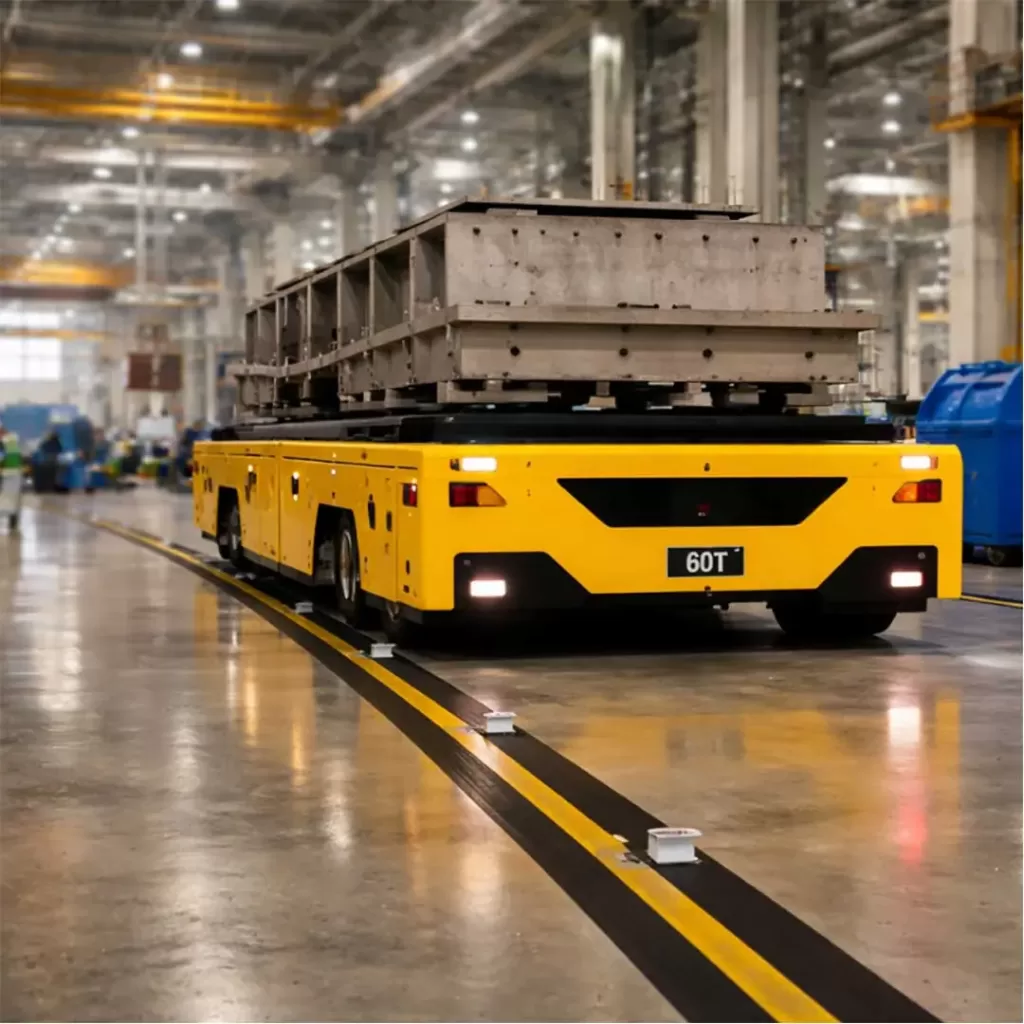
Magnetic navigation is a classical fixed path AGV navigation technology. Its core principle is to lay magnetic strips or nails along preset paths; The on-board magnetic sensor of heavy AGV recognizes the magnetic field signals and conducts real-time navigation. RFID tags are installed at intervals along the route, allowing the AGV to control start/stop and speed between segments and calibrate its position at each RFID location. It is composed of magnetic nail sensors, inertial navigation, encoder and magnetic nails, and has the characteristics of simple algorithms, low cost of sensors and easy engineering implementation.
For heavy duty AGV, the advantages of magnetic navigation include low deployment cost, mature stability and basic positioning accuracy in fixed path scenarios. However, it lacks flexibility-the path adjustments requires re-laying magnetic strips/nails, damaging floors and increasing costs. Magnetic media are also vulnerable to factory metal environments and wear from heavy-duty AGVs, leading to high maintenance costs and frequent material replacement.
1.2 QR Code Navigation: High-Precision Positioning with Moderate Flexibility
Two-dimensional code navigation is a high-precision technology widely used by modern industrial AGV robots, which is very suitable for precise docking and fixed-point transportation. The factory system sends pre-planned routes to the AGV, which uses inertial navigation combined with evenly distributed QR codes to correct its path. For example, if the route is straight for X meters and then upward for Y meters, the AGV will drive 1 meter by inertia (one QR code per meter), scan the code, calculate the deviation and adjust the direction, and repeat until the task is completed.
Navigation QR codes are typically 85 × 85 × 1.2 mm PVC labels, attached with 3M adhesive for waterproofing. Using a 16-code format, they remain readable even if more than 30% is damaged, reducing the risk of scanning failures caused by dust. Laser reflectors (Φ 80 × 700 mm PVC cylinders with reflective film) assist positioning—wall-mounted for enclosed areas, column-mounted for open spaces (3 sets per 10 meters, asymmetrically placed). Covering the area of 1000 * 1000 m, the high-precision positioning of AGV and material vehicle is realized by scanning the two-dimensional code.
The advantages of two-dimensional code navigation are high positioning accuracy and moderate flexibility-you can modify the route by re-pasting labels without causing significant damage to the ground. However, in the heavy-load and high-pollution factory environment, ground QR codes is easily worn, covered or damaged by heavy AGV and goods, which increases the maintenance workload. It also relies on pre-laid labels, which limits the flexibility in dynamic operation areas where the path is frequently changed.
1.3 SLAM navigation: a flexible “king” in a complex dynamic environment
SLAM (Simultaneous Localization and Mapping) is the most advanced navigation technology for heavy-duty AGVs, ideal for complex environments like human-machine mixed areas. In unknown environments, AGVs use internal sensors (encoders and IMU) and external sensors (LiDAR) for real-time positioning and incremental map construction. Laser SLAM AGVs match odometer and laser data with maps to achieve accurate positioning, plan real-time paths and send control commands. For accurate stop, you can add QR codes for mixed navigation, combining the flexibility of SLAM and the accuracy of QR code.
The advantages of SLAM navigation in complex factory environment are irreplaceable: extreme flexibility in dynamic and man-machine mixed scenes (no physical marking, real-time path planning); Strong anti-interference performance (the laser/vision sensors works stably in dust, occlusion and complex terrain); Low long-term costs (no marking maintenance, less workload). Its only minor disadvantage is that the initial R&D and deployment costs are slightly higher, which can be compensated by scale and frequent path adjustments. The table below provides a detailed comparison of the three navigation technologies.
In order to visually compare the differences between the three core navigation technologies and facilitate the decision-making of the factory, the following table summarizes their key performance indicators, advantages and disadvantages and applicable scenarios.
| Navigation Technology | Positioning Accuracy | Path Flexibility | Deployment Cost | Maintenance Cost | Anti-Interference Ability | Applicable Scenarios |
| Magnetic Navigation | ±10-20mm | Low (fixed path, hard to adjust) | Low | High (frequent replacement of magnetic media) | Weak (easily affected by metal environment) | Fixed-path, low-precision heavy-duty handling (e.g., dedicated workshop transfer lines) |
| QR Code Navigation | ±5mm | Medium (adjustable by re-pasting labels) | Medium | Medium (regular inspection and replacement of labels) | Medium (affected by label wear and pollution) | High-precision docking, fixed-point transportation (e.g., automated warehouse, assembly line) |
| SLAM Navigation | ±3-5mm (hybrid with QR code: ±2mm) | High (real-time path planning, no physical markers) | High (initial R&D and sensor cost) | Low (only regular sensor calibration) | Strong (resistant to dust, occlusion and metal interference) | Complex dynamic environments, human-machine mixed operation, indoor/outdoor mixed handling |
The data in the table is derived from the authoritative industrial intelligence website IndustryWeek (a leading English website focusing on industrial manufacturing and intelligent logistics), whose 2025 report on heavy-duty AGV navigation technology comprehensively sorts out the performance indicators and application scenarios of various navigation technologies, providing reliable data support for factory selection decisions.
2. Scenario Decision Matrix: How to Select Heavy-Duty AGV Navigation Technology?
There is no “one-size-fits-all” navigation technology for heavy-duty AGVs. The selection must be based on the actual factory environment and operation requirements. Combining the four core dimensions of factory logistics operation, we have formulated a professional scenario decision matrix to help decision-makers make scientific choices.
2.1 Dimension 1: Environmental Dynamic Level
For factories with fixed paths (e.g., dedicated workshop conveyor lines with no path adjustments), magnetic navigation or QR code navigation is suitable for low-precision requirements and high-precision docking scenarios. For dynamic working areas (man-machine mixed workshops, flexible production lines), SLAM navigation (or mixed SLAM+ QR code) is the best because its real-time path planning adapts to environmental changes.
2.2 Dimension 2: Floor Construction Cost
SLAM navigation is best in the renovation of old factories (no ground renovation); QR code navigation is a secondary option (only pasting labels), while magnetic navigation is not recommended (destroying the laying magnetic strips or nails on the floor). For new factory planning, all three technologies are viable, with trade-offs based on cost and operational needs.
2.3 Dimension 3: Heavy-Duty Stability Requirements
Heavy AGV is often used to transport oversized and overweight goods (such as fan main engines, transformers, mold, etc.), which requires high navigation stability and anti-interference ability in complex road conditions (such as uneven ground, metal environment in factories, dust and oil pollution). SLAM navigation has the strongest anti-interference ability, and lidar can stably identify environmental features in complex road conditions; Two-dimensional code navigation is stable under the condition of regular maintenance of labels; Magnetic navigation is easily influenced by the metal environment of the factory, and the stability will decrease when the magnetic medium is worn, so it is suitable for simple road conditions with little metal interference.
2.4 Dimension 4: Post-Maintenance Convenience
From the point of view of post-maintenance, the maintenance cost of SLAM navigation is the lowest, and there is no need to maintain physical markers, just need to calibrate sensors and update the system regularly; QR code navigation requires regular inspection, cleaning and replacement of broken labels, and the maintenance workload increases with the expansion of the application fields; Magnetic navigation has the highest maintenance cost, requiring regular replacement of worn magnetic strips/nails, and re-laying work is required when the path is adjusted, which consumes a lot of manpower and material resources.
3. Customized Solutions and Product Matching of LONYU Robot
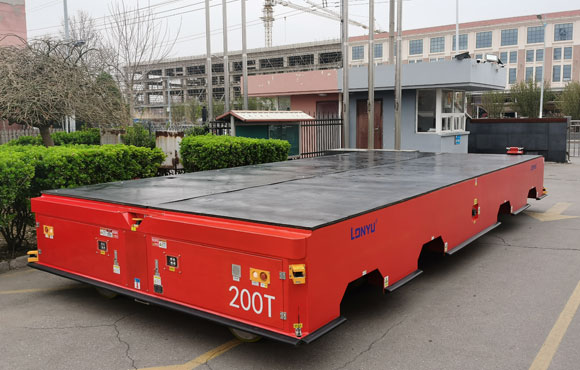
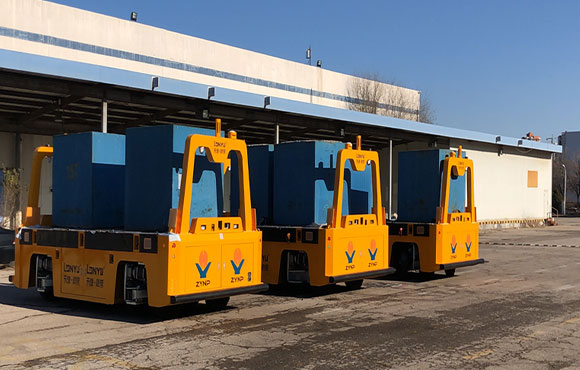
As a leading AGV manufacturer focusing on heavy-duty AGV and AMR solutions, LONYU integrates the three core navigation technologies into its entire product line to provide customized solutions with independently developed algorithms. Its 60T/80T/200T Trackless Transfer Carts, 150-ton Heavy-duty AGVs, Outdoor Unmanned AGVs and Automatic Mold Transfer Systems all feature adaptive navigation systems, perfectly solving the pain points of heavy-duty material handling in different complex factory and industrial park environments.
3.1 Product Recommendation 1: LONYU Latent Lifting Heavy-Duty AGV (QR Code/SLAM Hybrid Navigation)
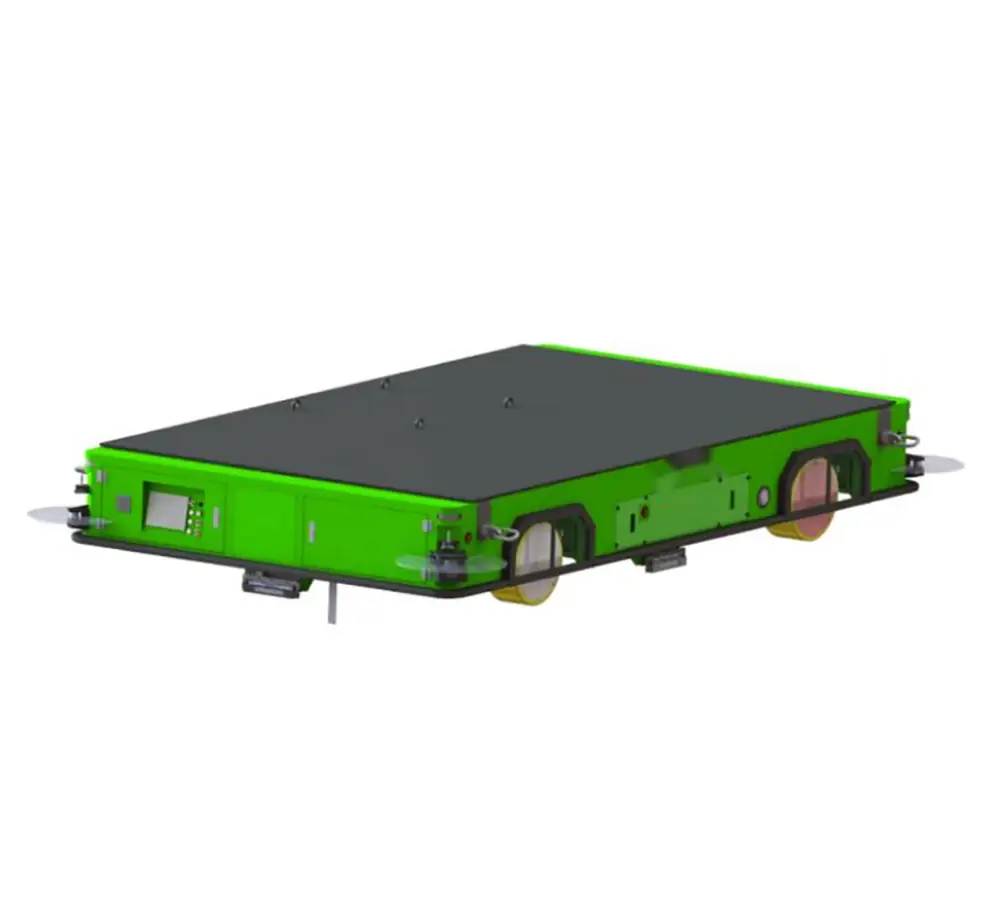
This product is mainly equipped with QR code/SLAM hybrid navigation technology, and is specially designed for AGV robot warehouse automated storage and compact assembly line heavy-duty handling scenarios. The hybrid navigation combines the high-precision docking advantage of two-dimensional code navigation with the flexible path planning advantage of SLAM navigation: in the fixed-point docking area of the warehouse and assembly line, the two-dimensional code positioning is used to ensure the docking accuracy of the AGV and shelves/machinery; SLAM navigation is used to realize real-time route planning in traffic sections with frequent route adjustments. This product is suitable for heavy-duty handling with medium load (60-80 tons), and provides a high-precision docking solution with a positioning error less than 5 mm, which can perfectly match the high-precision operation requirements of automatic warehouses and compact assembly lines.
3.2 Product Recommendation 2: LONYU Large-Tonnage Automatic Forklift/Heavy-Duty Platform Cart (Laser SLAM Navigation)
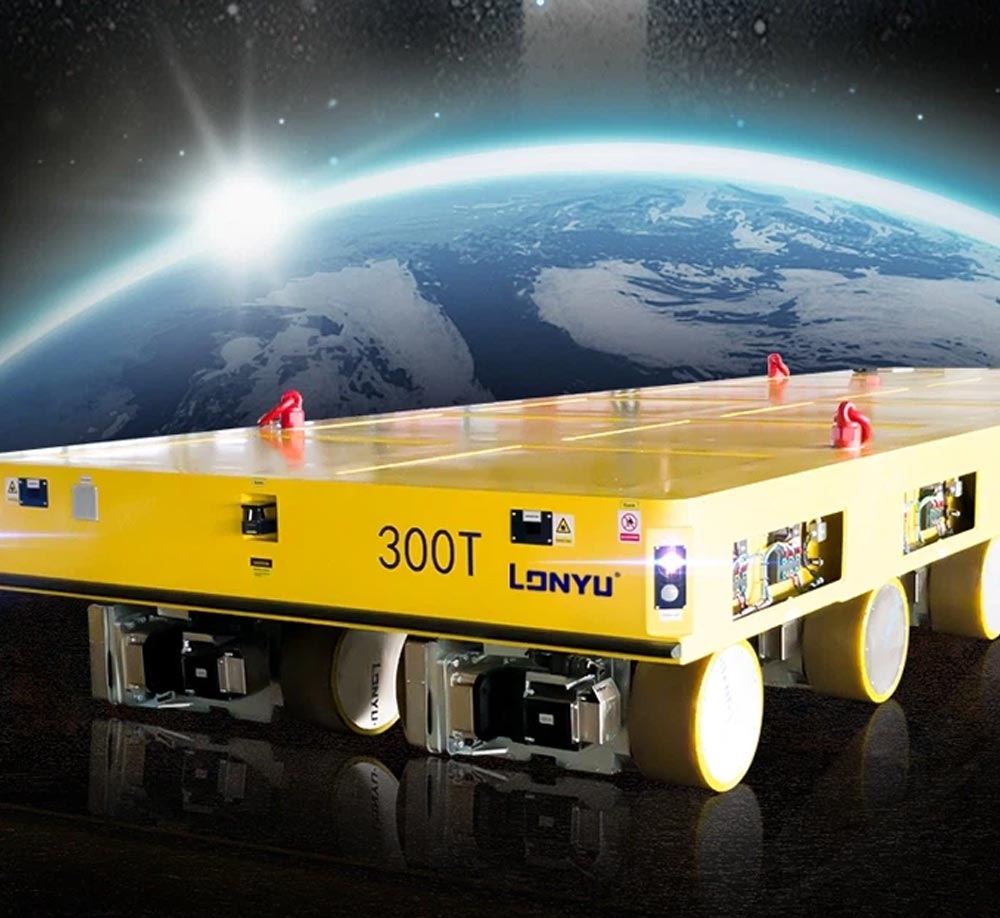
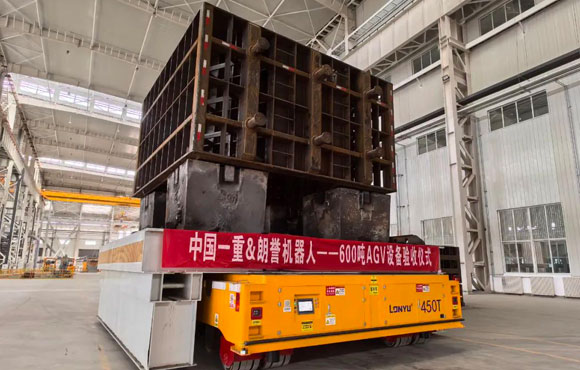
LONYU’s core products-80t/200t trackless transfer vehicles and large-tonnage automatic forklifts/heavy platform vehicles-are designed for complex workshops, long-distance logistics and indoor/outdoor mixed handling areas (such as fan main engine/drive system transportation) by using laser SLAM navigation independently developed. Its independent SLAM algorithm is resistant to dust, occlusion and metal interference, maintaining stability and accuracy; It also supports SLAM+ two-dimensional code mixed navigation to achieve high-precision stop. The 200 T Trackless Transfer Cart is the star product for the wind power industry heavy component handling, while the 150-ton Heavy-duty AGV excels in oversized and overweight cargo transportation scenarios with its ultra-strong load capacity and stable navigation performance.
3.3 Core Advantages of LONYU Robot’s Heavy-Duty AGV Products
LONYU heavy AGV has three core advantages: modular design (easy to maintain and upgrade), ultra-high load capacity (60-200 tons, super-large goods can be customized), and a perfect after-sales system (1-hour response, 3-hour on-site service, 24-hour solutions, 12-month warranty, and free software upgrade after warranty).
4. FAQ About LONYU Robot’s Heavy-Duty AGV Navigation Technology
Q1: Can the SLAM navigation heavy-duty AGV maintain stable operation in the factory environment with serious dust and occlusion?
A: Yes, LONYU Robot’s laser SLAM heavy-duty AGV is equipped with high-precision LiDAR and multi-sensor fusion technology (LiDAR + IMU + encoder), and the algorithm independently developed has strong anti-occlusion and anti-dust ability. Even if the lidar is partially blocked or the environment is seriously dusty, the AGV can still achieve real-time positioning and path planning through the fusion of multi-sensor data. At the same time, the sensor is equipped with a dust-proof and waterproof protective cover, which is specially designed for the harsh factory environment.
Q2: Can the QR code/SLAM hybrid navigation AGV realize seamless switching between indoor and outdoor handling?
A: Yes, LONYU’s hybrid navigation system has an independent environment adaptation module, which can automatically identify the indoor and outdoor environment features and switch the navigation mode in real time. In the indoor environment, the SLAM navigation is mainly used for high-precision positioning in combination with indoor maps of factories; In the open outdoor environment, the system will increase the weight of lidar and GPS-assisted positioning to ensure the stable operation of the AGV in the outdoor complex terrain. The company’s outdoor unmanned AGV flatbed car is a typical product for indoor and outdoor mixed handling. With its excellent navigation adaptability, it is widely used in raw material handling, workshop transshipment, explosion-proof chemical transportation, outdoor container transportation and other fields in industrial parks.
Q 3: How can existing heavy-duty AGV navigation systems in factories be upgraded?
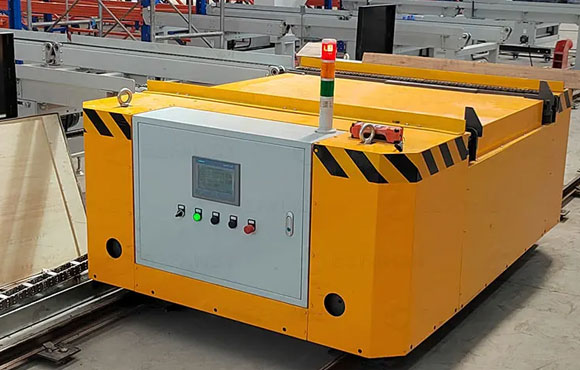
A: LONYU Robot provides a one-stop navigation system upgrade service for the factory’s existing heavy-duty AGVs, covering all our product lines, including Trackless Transfer Carts, Outdoor Unmanned AGVs and Automatic Mold Transfer Systems. Due to the modular design of LONYU navigation system, the original magnetic navigation or two-dimensional code navigation system of the AGV can be directly replaced with SLAM navigation or hybrid navigation system, without large-scale modification of the main body of AGV. The company’s R&D team will conduct on-site environmental test and AGV body suitability evaluation for the factory, and provide a customized upgrade plan to complete the installation, debugging and employee training in the shortest time.
5. Why Choose LONYU Robot as Your Heavy-Duty AGV Partner?
LONYU, founded in 2008, is a professional AGV manufacturer with over 300 employees and an annual output of over 2,000 vehicles. It integrates mechanical, electrical, software and system research and development, and is good at integrating navigation algorithms and sensor. Its products are widely used in wind power, transformers and shipbuilding.
In addition to technical strength and mature products, LONYU provides one-stop service covering the whole life cycle of AGV: on-site testing, customized design, installation, commissioning, staff training and 24-hour after-sales support. Adhering to the concept of “dedication, professionalism, pragmatism and development”, LONYU solves the pain point of heavy-duty handling in factories and promotes the intelligent transformation of logistics.
6 Summary
In the complex factory environment of Industry 4.0, the choice of heavy AGV navigation technology is not a simple “advanced or not” choice, but a scientific trade-off based on the actual operation requirements of the factory, including environmental dynamic level, floor construction cost, heavy stability requirements, convenience of later maintenance and so on. Magnetic navigation is an economical and effective choice for fixed path and low accuracy; Two-dimensional code navigation is suitable for fixed-point docking and moderate flexibility scenes; And SLAM navigation (or SLAM+QR code hybrid navigation) is the optimal solution for complex dynamic environments, human-machine mixed operation and indoor/outdoor mixed handling scenarios—this is also the development direction of heavy-duty AGV navigation technology in the future.
As a professional AGV manufacturer focusing on heavy duty AGV, LONYU integrates the three core navigation technologies into its entire product line, including trackless transfer vehicles (60 t/80 t/200 t), 150-ton heavy AGV, outdoor unmanned AGV and automatic mold transfer systems. Leveraging strong independent R&D capabilities and extensive industry experience, LONYU provides customized navigation and handling solutions for various scenarios. Its high-quality products, perfect after-sales service and one-stop logistics solutions provide support for the factories in the aspects of heavy-duty handling automation and “reducing cost and increasing efficiency”.